I’m a journalist, travel writer, editor and copywriter based in Melbourne, Australia. I write pacy travel features, edit edifying websites and fashion flamboyant copy. My articles and photographs have appeared in publications worldwide, from inflight to interior design: I’ve visited every continent, and have lived in three. Want to work together? Drop me a line… 

Follow


The new world order: Myanmar and Sri Lanka our must-do destinations

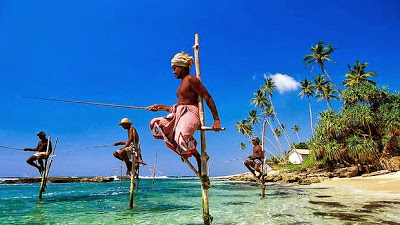
Stilt fishermen in Sri Lanka. Photo: Alamy
Myanmar and Sri Lanka top the list of must-do destinations,
industry experts agree. 
CHRIS ZEIHER
Lonely Planet
My pick for 2014 is Riga, the art nouveau jewel of the
Baltics. The Latvian capital is a twin to Prague, minus the fleets of tour
buses and crowds, and is the 2014 European Capital of Culture.Next year is all
about indulgence for me: I’ll be travelling to stunning Waiheke Island off
Auckland to celebrate my birthday.
DAVE BOYTE
Skyscanner.net
Brazil will be in the limelight, thanks to the football World
Cup. We’ve seen increased interest in Myanmar and Cambodia and Sri Lanka is a
rising star: visit the fort town of Galle. Mount Kinabalu (4095 metres) is the
highest mountain between the Himalayas and New Guinea: let’s see if I am up for
it.
SUJATA RAMAN AND GEOFFREY KENT
Abercrombie & Kent
Sri Lanka is still remarkably unspoiled, with ancient cities,
tea plantations and hill stations vying for attention alongside amazing
wildlife, temples and golden beaches, while Myanmar is a truly spiritual
destination. In 2014, you will be able to travel along the Ayeyarwady River on
the boutique river cruiser, Sanctuary Ananda, through stunning landscapes.
JAMES THORNTON
Intrepid Travel Group
Myanmar is Asia’s hottest new destination: get even further
off the beaten track and set sail around the 800 islands of the blissful Myeik
Archipelago. Sri Lanka is rising in popularity, and with all eyes on South
America for the World Cup, my tip is to escape the crowds in Colombia.
Outdoor dining in Istanbul. Photo: Getty Images
SALLY GODFREY
Homeaway Holiday Rentals
Internationally, Dubai, Istanbul, Phuket, Kyoto and Tel Aviv
are receiving strong booking inquiries for 2014, while domestic mainstays are
Gold Coast, Byron Bay and Sydney. Rising stars include Seminyak, Boracay and
Goa and the holiday rental market is becoming more popular in South-East Asia.
I will be hitting the slopes of Queenstown, sunning on a Bali beach and catching
some weekend respite on Phillip Island.
ROWENA FITZGERALD
Mr and Mrs Smith
Lanterns in Kyoto. Photo: Getty Images
People are looking for accommodation that offers an authentic
connection to the destination, such as smaller, locally owned boutique hotels
like Brody House in Budapest or Claska in Tokyo. We’re seeing a surge in
interest in Japan, prompted by its distinctive pop culture and increased
flights. I’m going to Costa Rica and Belize for their beautiful beaches,
incredible diving, and unspoilt rainforest. I hope to stay at six-suite hotel Kura.
RICHARD MOLE
Byroads Tours
Sri Lanka is safe, easy to get to and great value, has an
excellent range of accommodation and offers both beaches and culture. In many
respects, it’s the new Bali. Myanmar is another one on my list. It still lacks
beds, so prices are unreasonably high, but it’s seen as Asia’s last frontier.
Cuba is in the same category – go before it changes forever! My left-field
prediction is Iran. The new government is clearly trying to build bridges with
the West.
THE LEGGY LOVELIES
Luxecityguides.com
Why sprint madly through an overcrowded airport when you can
transfer leisurely and luxuriously via riverboat? We like Heritage Line’s
(heritage-line.com) vintage-inspired fleet for South-East Asian jaunts. For gastro-travel, Copenhagen, Lima, Bangkok and Tokyo are
emerging as envelope-pushing culinary destinations. Pack your elastic-waist slacks! There’s very good bang for
your buck. Quaint boutique hotels and delicious street foods keep it cheap,
cheery and culture-savvy. South America is booming but we also intend to escape the
crowds in Mongolia and Myanmar.
 

The delights of Noma in Copenhagen. Photo: NY Times
SIMON McGRATH
Accor Hotels
After slowing in 2012-13, Bali is becoming popular again for
Australians. Our top picks are Sydney for its great 2014 events line-up,
Tropical North Queensland for beach and adventure travel and Adelaide, just
named in Lonely Planet’s Best in Travel 2014 roundup, with a focus on culture
and the arts. With an increase in low-cost airlines flying into Adelaide and
Cairns, accessibility has never been easier. I’m heading to Terrigal, NSW,
close to home, for a great Australian beach holiday.

Compiled by Belinda Jackson for the Sydney Morning Herald/The Age newspapers

Six of the best: hotel openings in 2014

The Shard, London. Soon to be home to Britain’s first Shangri-La hotel.

It’s that time of year again, when the wrap-ups are wrapped, the forecasts are cast and we all enjoy a little panicking to get it all tied up neatly in time for a beach Christmas. I’m absurdly interested to see Hayman Island’s reincarnation, and, having just arrived back from London, have renewed a love affair with that city and all that’s glitzy and good in it.

SHANGRI-LA,
ENGLAND

The first
Shangri-La hotel in Britain will have London’s best address, at the Shard,
Western Europe’s tallest building, designed by starchitect Renzo Piano. Set in
the London Bridge quarter, each of the 202 rooms come with butlers and
floor-to-ceiling views to St Paul’s Cathedral, Tower Bridge and the Tower of
London. Level 52 is the domain of Hong Kong’s darling architect Andre Fu (of
Upper House fame), where you’ll find Gong, London’s highest cocktail bar, and a
sky-high infinity pool. Word on the street is it’s to open summer 2014 but
there’s no official date from the hotel yet and prices are still to be
released. See shangri-la.com.
The much-anticipated Peninsula Paris.

PENINSULA
PARIS, FRANCE

It’s
taken more than four years of work but The Peninsula Paris has finally declared
it will open on August 1, 2014. Expect 200 rooms, a rooftop bar and underground
spa and hey, because this is Paris, a cigar lounge as well. The wraps are now
off the 100-year-old Beaux-Arts building in the fancy 16th arrondissment, with
views to the Arc de Triomphe, as befits the group’s first foray into Europe.
For your gastronomic pleasure there’s Cantonese being dished up inside, French
fare on the roof and a Chinese tea counter. Rates have not yet been released. See
peninsula.com.
SOFITEL
SHANGHAI JING’AN, CHINA
Shanghai’s
already fabulous hotel scene gets a new player when the city’s third Sofitel
opens just off the iconic shopping strip of Nanjing Road. In keeping with most
Chinese hotels, it’s big: we’re talking 503 rooms, with a cocktail bar at the
top of the 68-storey art deco-inspired building and French-meets-Chinese
cuisine being talked up. There’s already been a two-year delay in its launch
but the group is planning a grand opening of what will become the city’s new
flagship Sofitel in September 2014. See sofitel.com.
CROMLIX,
SCOTLAND
Fancy
angling for trout, stalking deer or wearing someone else’s tartan? Wimbledon
champ and local lad Andy Murray has taken over this classic country house and
opening is set for April 1, 2014 (yes, really). Built in 1874, Cromlix has just
15 rooms and suites, each named after a great Scot, and is close to Gleneagles,
which hosts next year’s Ryder Cup. You won’t starve: the kitchen is under the
deft hand of Albert Roux, responsible for Britain’s first three Michelin-star
restaurant. Cromlix is just outside Andy’s home town, Dunblane, and less than
80 kilometres from both Glasgow and Edinburgh. From £200 ($350) a night. See cromlix.com.
Hayman Island’s iconic pool shot.

ONE&ONLY
HAYMAN ISLAND, AUSTRALIA

It was the
talk of the town when it was announced that the uber-luxe hoteliers of
One&Only Resorts, who play in all the best addresses including the Bahamas,
Maldives and Dubai, are taking over the iconic Great Barrier Reef resort.
Thankfully, the pool wing will be carved into new all-suite accommodation
including private pool terraces; that much-photographed lagoon pool will be hit
with cabanas and daybeds and there’s also a new adults-only pool and chill-out
lounge. And forget foreign backpackers spinning up fishy tales, your guides to
the reef will be dive experts and marine biologists. The new Hayman opens April
2014 (actually, make that July 1, 2014: BJ), from $730 a night. See hayman.com.au.
SEA
SENTOSA ECHO BEACH, INDONESIA
It hasn’t
even opened yet and already this Balinese beachfront resort has won world’s
best apartment at London’s International Property Awards. Located just north of
Seminyak on Canggu’s legendary surf beach, the 68-apartment resort features
“living walls” or vertical gardens by French botanist-designer
Patrick Blanc, a lagoon for your front yard and views straight out onto the
Indian Ocean. If looks are anything to go on, its two beach restaurants,
complete with sand beneath your feet, are set to rival those of Ku De Ta and
Potato Head when the resort opens come July 2014. From $175 for a garden
studio. See seasentosa.com.
By Belinda Jackson. This article first featured in the Sydney Morning Herald/The Age Traveller

20 reasons to visit Colombo, Sri Lanka

Colombo classic: The historic Galle Face Hotel.
Colombo classic: The historic Galle Face Hotel. Photo: Getty Images

1 PETTAH
Brave the streets of Pettah to pick up everything from
fabrics and fruit to watches and wedding invitations. “It’s utter
chaos,” the locals cheerfully admit. “You can get a suit made in two
hours, though it may last only three.” The streets are crammed with
saris, electronics and ayurvedic medicines, while the fruit and
vegetable market heaves with sacks of outrageously fierce-looking
chillis.

2 GALLE FACE GREEN
 It’s easy to forget Colombo is a seaside city when you’re
stuck in a 1pm traffic snarl on the Galle Road. The best way to
reconnect with the Indian Ocean is by making like a local and
promenading on the Galle Face Green. Sundays are a big day for local
families, kite flyers and food trucks serving deep-fried snacks.

3 SRI LANKAN CRAB
Singapore’s famed chilli crabs actually come from Sri Lanka,
so go back to the heart of it all at Ministry of Crab, one of
Australian-Sri Lankan chef Peter Kuruvita’s top picks on the Colombo
dining scene. It may be the priciest place in town, but chef Dharshan
Munidasa’s cooking is worth it (ministryofcrab.com). Crab gets the Tamil
treatment on Sundays in a Jaffna-style crab curry at Yarl (56 Vaverset
Place, Wellawate, Colombo 6) or little sister Yarl Eat House (Cnr Galle
and Station roads, Wellawatte).

4 OLD DUTCH HOSPITAL
Until recently, the Old Dutch Hospital was a crumbling ruin.
Dating from 1677, it’s the oldest building in town and now its long, low
courtyards are Colombo’s new heart. It’s a one-stop shop for clothes
and gifts, spa treatments, chic dining, serious tea drinking at Heladiv
Tea Club or more relaxed pizza and steins of beer at Colombo Fort Cafe.
Come nightfall, it’s a buzzy hotbed of locals and tourists.

5 CLOTHES SHOPPING
Odel is Colombo’s fashion house of choice (5, Alexandra Pl,
Col 7) and KT Brown its designer, with ethnically inspired designs (7
Coniston Place, Col 7, ktbrownstudio.com).
For leaner budgets, Cotton Collection (143 Dharmapala Mw, Col 7) has
fab finds and nearby Kelly Felder (117 Dharmapala Mw) employs only local
designers with new stock every Tuesday. For cool beachwear, check out
the super-colourful Arugam Bay label, in Odel, Barefoot and their
showroom (32 Ward Place, Col 6), which is also home to contemporary
Buddhi Batiks. Grab a tuk-tuk and skip between ’em.

6 BAREFOOT
It’s a cafe, an art gallery, a performance space and shop.
Established 40 years ago by Sri Lankan artist, entrepreneur and
philanthropist Barbara Sansoni, its signature style is hand-woven,
hand-dyed yarns made into brightly coloured children’s toys,
free-flowing clothing and fabrics manufactured ethically by women across
the country. Also one of the best places for books on Sri Lanka (704
Galle Road, Colombo 3 and Old Dutch Hospital, barefootceylon.com).

7 BOUTIQUE HOTELS
It’s a small country and Sri Lanka has embraced the small,
boutique hotel concept. Lovers of classic interiors head to style guru
Shanth Fernando’s 10-room Tintagel (tintagelcolombo.com) while Casa Colombo is a playful (some would say over-the-top) 12-suite remake of a 200-year-old mansion (casacolombo.com). Park Street Hotel mixes minimalism and antiques (asialeisure.lk) while Lake Lodge’s 13 rooms overlook South Beira Lake (taruhotels.com). Newcomer Colombo Courtyard doesn’t have the design pedigree but it’s small and centrally located (colombocourtyard.com). Because of a government tariff, Colombo hotels aren’t cheap. They also book up quickly, so get in early.

8 AYURVEDIC SPAS
The subcontinent’s traditional ayurvedic medicine morphs into
a sublime spa experience at the Siddhalepa Ayurveda Spa (33 Wijerama
Ma, Col 7, siddhalepa.com) or Spa Ceylon, with its scents of white tuberose, red sandalwood and jasmine (Dutch Hospital, Park Street Mews, spaceylon.com).
A warning: be prepared for days of oily hair or plenty of hair washing
if you’re signing in for Shirodhara, where warm oil is continually
dripped onto your third eye (forehead).

9 ART MARKET
Support local artists with a visit to Colombo’s kala pola
(art market) on Sunday mornings, where affordable artwork is hung around
Viharamahadevi Park (Col 7). If you miss the market, Saskia Fernando
Gallery exhibits Sri Lanka’s top artists (61 Dharmapala Ma, Col 7) or
cool down at artist Harry Pieris’ serene Cinnamon Gardens mansion, the
Sapumal Foundation (34/2 Barnes Place, Col 7). Barefoot and Paradise
Road Gallery and Cafe (2 Alfred House Road, Col 11) show and sell the
country’s greats.

10 GEM & JEWELLERY SHOPPING
Sri Lanka is most famous for its blue sapphires, as worn by
the British royals. Slip in to premier gem dealer Colombo Jewellery
Stores for a quick education and check out the well-priced men’s watches
while you’re there (1 Alfred House Gardens, Col 3, also Old Dutch
Hospital, Galle Face Hotel, cjs.lk). Ridhi is a good stop for affordable silver jewellery (74 Lauries Road, Col 4, ridhi.lk).

11 SUNDOWNERS
The verandah of the Galle Face Hotel, looking over the Indian
Ocean, is the place to be seen for a sunset cocktail or dinner
aperitif. The grand dame has been swizzling sticks since 1864. Budget
alternatives include the sleepy rooftop bar of the Colombo City Hotel
beside the Dutch Hospital, or join the locals on Galle Face Green with a
bottle of pop.

12 CRICKET
Go to a cricket match. “There’s no sledging here, it’s just a
big party,” swear the locals. Catch the internationals at the R.
Premadasa Stadium. For more slap of leather on willow, pop in for lunch
and current matches or old classics on the many big screens at the
Aussie-owned Cricket Club Cafe, (34 Queens Road, Col 3, thecricketclubcafeceylon.com).

13 TEA TASTING
Taste some of the world’s finest teas at Mlesna Tea Centre
(89 Galle Road, Col 3) or the Australian favourite, Dilmah Tea Shop (5
Alexandra Pl, Col 7). If you can endure the seriously lacklustre service
in the government-owned Sri Lanka Tea Shop, you’ll find a broad range
of teas, from working-class brews to elaborately packaged gifts.

14 WALKING TOUR
Colombo local Mark Forbes takes you by the hand through the
Portuguese, Dutch and British architecture and influences on Colombo.
Pause for a cuppa, butter cake and harbour views at the Grand Oriental
Hotel, which dates from 1837, before continuing on through the Pettah
markets and into the ramshackle 180-year-old mansion that is the Dutch
Period Museum (colombocitywalks.com).

15 SHORT EATS & HOPPERS
Colombo’s short eats are a vast collection of pastries with
such fillings as curried chicken, seeni sambol (caramelised onion) and
fabulous fish rolls. Kollupitiya, in Colombo 3, is fertile hunting
ground for short eats cafes: try Perera & Sons’ modern, super-clean
branches (2 Dharmapala Mw), stalwart The Fab (474 Galle Road), Cafe on
the 5th (108 5th Lane) or Sponge, which many rate the top short eatery
in town (347 Galle Road). Hit local fave Green Cabin for hoppers, thin
pancakes made with coconut milk, designed to scoop up curry sauces (453
Galle Road). Don’t expect gushing service.

16 UNIQUE SOUVENIRS
Resist globalisation and discover unique, locally produced
artisan products: find textural elephant dung paper, ceramics at the
government-owned handicrafts shops Laksala (60 Fort St, Col 1) and
Barefoot’s signature bright woven linens. Sri Lanka’s premier homewares
store, Paradise Road, prints the curvaceous Sinhalese alphabet and
elephant motifs on to household linens in a palette of black and French
beige (213 Dharmapala Mw, Col 7). Find affordable gifts at Casa Serena
(122 Havelock Rd, Col 5) or try Lakpahana (14, Phillip Gunawardena Mw,
(Reid Ave, Col 7), Suriya (39 Layards Rd, Col 5).

17 FEEL-GOOD TOURISM
Shop for fair-trade toys, ethically produced food and craft
at the kid-friendly Good Market, every Thursday from noon-8pm (Water’s
Edge Park, Battaramulla, thegoodmarket.lk). The Warehouse Project gives
good reason to eat more cake: profits from its Wonderbar soul food and
Cakes for a Cause projects help run community programs for the local
Maradana population. Email for a tour of the watta (shanty community).
See warehouseproject.lk.

18 MULTI-FAITH VOYEURISM
Pick a religion, you’ll find an elaborate place of worship in
Colombo: the Buddhist Gangaramaya temple on Beira Lake was designed in
part by the influential architect Geoffrey Bawa. Wolvendaal Church is
the country’s oldest Protestant church, from 1749, while the red and
white striped Jami-Ul-Alfar is open for visitors except during prayer
times. For a hit of intricacy, visit a Hindu kovil: the old and new
Kathiresan Kovils in Pettah were built to appease the war gods. The
Catholic St Lucia’s Cathedral is modelled on St Peter’s Basilica in the
Vatican and the Sambodhi Chaitiya is a shining white dagoba (stupa)
raised so seafarers could see it offshore.

19 THE FORT DISTRICT
Fort is the heart of Colombo, named for the 17th-century,
Dutch-built ramparts pulled down by the Brits in 1879. Its modern face
is the glitzy World Trade Centre (where you can get a decent coffee) and
the revitalised Old Dutch Hospital. Its British Raj face is undoubtedly
the gothic pink-and-white Cargills Building on York Street, the Old
Parliament building (1930), the old GPO (1891) and the Lighthouse Clock
Tower, built two years before London’s Big Ben, in 1857, now towered
over by skyscrapers.

20 MOUNT LAVINIA
Dive into the Indian Ocean at Mount Lavinia, half an hour
north of central Colombo. The waters are far cleaner than off the Galle
Face Green and the beach is lined with seafood restaurants. For a taste
of luxury, check into the five-star British colonial Mount Lavinia Hotel
for colonial-style High Tea overlooking the ocean, from 3.30pm daily (mountlaviniahotel.com).


By Belinda Jackson, published in the Sun-Herald newspaper.

Bill Clinton, Norwegian chess and the depths of the polar night: on the Hurtigruten

The view from the Panorama Lounge on
decks 8 and 9, MS Midnatsol.

This morning was spent eavesdropping on two old fellas from San Diego: from taking photos with Bill
Clinton, to Russia as a re-emerging military power and car parking in downtown San Diego.
On this
journey on the Hurtigruten, from Kirkenes in far northern Norway to Bergen in the south, the guests are predominantly British, American and German. I catch Australian accents more times than I
expected, many drawn by the lure of spotting the Northern Lights.  

There is also a substantial
smattering of Norwegians using the ship for its original purpose: as a means of transportation between the country’s coastal towns and cities.

The
Hurtigruten is a route, not one particular ship (‘hurtig ruten’ = fast route’). A ship leaves Bergen every day of the year and has
been doing so since 1936, interrupted only by wars. My ship is the MS Midnatsol,
(Midnight Sun) built in 2003 and with 644 berths, can take up to 1000
passengers.
One of the many lounges on the MS Midnatsol,

The oldest
ship, the MS Lofoten, was built in 1964 and takes just 153 passengers.
Apparently it’s very popular with tourists, though locals fight to understand
why. “It’s just an old barge, compared with the Midnatsol,” one tells me. 

Our cabin
is a cosy little affair: two couches fold down to make comfortable beds,
there’s a little desk and a bathroom. There are hooks and nooks to tuck your
gear away in, though the ship’s lounges, cafes and libraries are preferable,
with their panoramic windows and wi-fi which, undestandably, gets a bit shaky when the weather is tossing the ship around on the stretches of open sea.
“You won’t
starve on the journey,” a waitress tells me sorrowfully. Our induction to the chef’s
hand is lunch, with five types of fish including roasted cod, gravalax (smoked
salmon), tubes of Mills Caviar and yes, today features a reindeer casserole
with onions and mushrooms.
The dining room on the MS Midnatsol.

Stopping at
coastal habitations, sometimes for less than 15 minutes, we’re encouraged to
jump off and explore, be it a polar bear museum, taking a dip in the Arctic pool on the open Deck 9 or listening to a midnight concert when we reach Tromso. With restaurants, gym,
auditoriums, laundry and saunas, it’s a floating world, yet unlike the global
cruise liners, all the staff are local or from neighbouring Sweden. 

And with reindeer pate
and caramelised cheese on the menu, live chess broadcasts on the local tv station and a gift shop full of toy trolls and
snowflake knits, it’s undeniably Norwegian.

Catching the light fantastic: the Northern Lights in Norway

The view from deck 9, MS Midnatsol. Photo: Belinda Jackson

I have seen
the light! The Northern Lights! That shimmering curtain of luminescent green
that cloaks the Arctic Circle in the winter months. 
Coy and as unpredictable
as the Sydney bus service, we struck it lucky by spying the lights on our very
first night on the ship. The lights made a brief appearance before dinner –
which only keen watchers managed to catch – but put on a post-dinner show for
all. They reappeared around midnight after the crowds had gone to bed, to dance
and skate across the sky for just a few of us well-rugged travellers on the
Hurtigruten, here in northern Norway.
“We waited
six nights before we saw anything,” a fellow cruiser told me, while helping me
set my camera to catch the phenomenon, which is the result of solar flares
hitting the Earth’s atmosphere. ISO ramped up, exposure 10 seconds, manual
focus, camera tied to a deck chair: for we photographic amateurs, it’s really a
case of pointing, shooting and hoping that something shows up at the end.
But let me
blow a few myths: if you were standing on deck in sub-zero temperatures at
midnight waiting for a ray of green light to hit you in the face, you’d be
waiting a long time. According to the ship’s guest lecturer Dr John Mason, most
of the colours in the Northern Lights are invisible to our eyes: we just can’t
see the red and turquoise bands with the naked eye. Green is the most apparent
colour, followed by violet, but even then, when you look into the sky, they show
up more like a hazy grey cloud against the clear black sky.
Point a
camera at the grey clouds and you’ll see the eerie green rays appear in your
final photo – and even then only when you open the lens for up to 15 seconds.
It’s not always like this, otherwise the Lights wouldn’t be in Sami folklore, long
before cameras became a natural extension of our arms.
The band of
green light was a bridge between earth and heaven upon which departed souls
would travel, a mystical, powerful force that is as strong a lure for us today. 

Norway asks: what does the fox say? ‘Brrrrrr.’

The new Astrup Fearnely museum, by too-hot architect Renzo Piano.
“I hear
it’s a bit of a backwater,” says an unnamed expat living in Sweden, looking
across at neighbouring Norway. Talk about winning friends… but I’ve heard this before, Swedes sniffing at what
they see as hard-smoking, hard-drinking Norwegians who are rich from oil, not
from hard work.
It’s the classic ‘fight-with-your-neighbours’ scenario. Think Britain and France. The USA and Canada. Australia and New Zealand.

If you
tuned into Norway’s national tv station NRK, you’d probably agree. Previous
programs include 12-hour features on stacking firewood, knitting and a minute-by-minute
program of the cruise/cargo ship route, the Hurtigruten, which makes its way up
and down the Norwegian coastline, from Bergen to Kirkenes. It was a 134-hour, non-stop
broadcast from one of the ships, and it rated its pants off.
“Did you
see the program?” an urbane concierge asks me at Oslo’s beautiful Grand Hotel. “It
was great!”
Elkburger at the face of new Nordic food, Kolonihagen,
in Oslo’s gritty Grunerlokka district.

“Sorry, can’t
say I did,” I reply. “But I’m going to be living it instead.”

After a day
in Oslo, where the nonsensical Norwegian hit song ‘What does the fox say?” blares
from cosy-looking bars, we fly to icy Kirkenes, way up in the northernmost tip
of Norway, in the Finnmark region, to start our trip.
To give you
an idea of the locale, Kirkenes is two hours’ flying time from Oslo, heading
due north, in the Arctic Circle. It’s 7km from the Russian border and 37km west
of Finland. Murmansk is 250km away, about four hours’ drive.
Looking out
of the plane window, the blackness is spotted infrequently with orange lights indicating
some sort of dwelling. The ground is white with snow and ice, slick with
running water and while the temperature reads a relatively balmy 2.2 degrees
(positive), the wind chill factor drags it down somewhere below zero.
“It’s quite warm for this time of year,” the
taxi driver tells me. “A few years ago, it was -20C in early November.” My face
starts to crack just at the thought of that cold.
Dinner is a
very red chowder with pepper, king crab and chunks of cod, and a reindeer
burger the size of a side plate: for all its insanely low temperatures, this is not a desert. The land provides.

I shopped the world’s largest IKEA and survived: Stockholm icons

This is not IKEA, this is Nybrokajen, one of Stockholm’s beautiful
waterfront streets. Far more picturesque. Photo: Belinda Jackson.

It’s been pretty wet here in Stockholm. I’ve traded Cairo’s sun for snow, Giza ponies for Dalarna horses. The people in both Egypt and Sweden both wear a lot of black, but instead of busting my chops to exercise in Ahly Sports Club in Cairo, today I did my daily walk in the world’s largest IKEA, in Kungens Kurva, in southern Stockholm.

The trip was an essential one for my brother, in the midst of renovations, but yes, I was keen for a perve.

Let me report back: the store layout is just as confusing as any other IKEA store, they really do eat meatballs and it was packed with families on a wet Sunday afternoon. One of the ninth hells? Quite possibly. However, some may be appeased by the revelation that they serve booze in the cafeteria with those meatballs. 

I was going fine until I split from the Swedish speaker and on the hunt for bathroom hooks, when I realised there are no English signs, a marked absence of staff and my shabby Swedish doesn’t include the word for ‘bathroom’.

Yes, it was big, mighty big. But I survived, and recuperated with the classic cinnamon bun, kanelbullar (dreadful version from a supermarket, here’s a recipe for a real one) and the delicious-sounding, but absolutely revolting saffron buns, lussekatter as well as västerbottensostpaj (a super-rich, super-fabulous cheese pie that rivals anything I ate in Cairo for cholesterol).

Next stop on a quest for all things Swedish: the new ABBA museum. Oh yeah, I’m ticking the boxes…

52 Weekends Away: food and wine in Gippsland

Temptation personified. Photo: Belinda Jackson

On a break from Cairo, here’s a little number from beautiful East Gippsland. If you’re in that neck of the woods (think Lakes Entrance way), make a beeline for this little beauty.
 
BAG END AT RIVENDELL

926 Stephenson Road, Tambo Upper, Vic
Phone: (03) 5156 4317 or 0419 302 074
Web: arkenstone.com.au

The location
Tambo Upper is an East
Gippsland hamlet located amid rolling farmland off the highway between
Bairnsdale and Lakes Entrance. Rivendell is a 44-hectare property built
on the hilltops; you can look out to the spectacular Gippsland Lakes, a
favourite spot for boaties, fishermen and birdwatchers.

The place
Rivendell is a working Angus beef farm with two self-contained cottages that have also been named after things or places in The Lord of the Rings
– Arkenstone, a wheelchair-friendly, three-bedroom cottage, and the
one-bedroom Bag End, which we stayed in. In an earlier incarnation, Bag
End’s bedroom was a concrete water tank; it’s still circular, but now
it’s filled by a comfy bed and lined with racks of wine, available for
purchase. Both cottages have well-equipped kitchens and there’s a spa
tub in the garden. The farm is home to peacocks and guinea fowl, sheep,
hens and horses.

The experience
Start the day with
owner-chef Josh Thomas’s excellent breakfast and end it with a
three-course dinner. In between, there’s always lunch: the nearby
Nicholson River Winery serves platters that complement its renowned
Gippsland pinot noirs. Rivendell hires canoes and mountain bikes to
enable visitors to explore the picturesque Tambo River and the East
Gippsland Rail Trail.

Don’t miss
East Gippsland’s vibrant
villages. Bruthen is at the start of the Great Alpine Road and here you
can sink a local brew at the Bullant Brewery before popping into the new
Bruthen Bazaar. Metung, on the water’s edge, has a thriving cafe scene
and breakfast at The Metung Galley is highly recommended. There’s also a
farmer’s market on the second Saturday of each month.

Need to know
Cost: From $240 a night.
Distance: 3.5 hours’ drive (310km) east of Melbourne.
Children: Yes.

This story, written by Belinda Jackson, is part of 52 Weekends Away, published in the Sydney Morning Herald newspaper.

Sign of the times at the pointy end of Egyptian tourism

Photo: Belinda Jackson
The first time I visited the Pyramids, I went through the front door with several hundred other foreigners, all lining up for a photo of ‘kissing’ the Sphinx or ‘holding’
a pyramid by the fingertips.
The other day,  I went round the back, where a
handful of guards nearly fell over to see someone, and the touts couldn’t believe their luck at not one, but two carloads of visitors, even if they were all Egyptian (including one suspiciously blonde one in the middle).
Sitting on the boot of our cars, they literally corralled us into a private car park to negotiate the hire of two caretas (carriages) and two horses.
Those who have been held hostage high on a camel until they paid up big will be pleased
to know not even the locals can resist the Giza Pyramid mafia.
A camel driver. Photo: Belinda Jackson
Let me tell you this: Egyptians visit the Pyramids in a whole different way to us foreigners. Toss the guidebook, forget about learning kings’ names and studying informative plaques earnestly.
It’s all about the photos, the freedom of the desert surrounds and the physicality of being beside something so magnificent, that you forget about the traffic jams, the pollution, the protests and the curfews that see you trapped indoors after 7pm on a Friday night thanks to the current army
curfew.
The newspapers are reporting an 80 percent drop in tourism to Egypt, which, based on what I saw at the Pyramids on a sunny autumn afternoon, should read more like 95 percent.
There were three young Americans, skinny, bearded and wearing
the obligatory Arafat scarf, there was a Euro-couple celebrating the
end of a Cape Town to Cairo adventure, and a small tour group of Russians
snavelling basement-bargain travel. That’s all.
Forlorn camel owners perked up when they saw us coming, and Giza’s notoriously
overworked and underfed horses were fleet of foot and ready to run. My little
grey mare, Sousou, is surely the fastest pony in Giza.
It’s been a very long time since I rode around the Pyramids in the daylight. Usually, I’d
ride on a full moon, flat out down the plateau at full gallop, breathing in the
cool desert night air. In broad daylight, it’s a whole different ballgame. You
see the stones the size of basketballs that your horse is dodging. You see the
concrete wall that the horses aim for at full tilt, before swerving left to
pass through the exit gate. You see the snarling curs that lick around the
ponies’ hooves, snapping at ankles as you pass.
It’s consoling to know that the Pyramids remain unchanged while Egypt twists and
wrenches itself into a new form. But the lesson from Afghanistan and China is
that you can never take even heroic art and architecture for granted.

Abu Simbel’s time to shine: Egyptian antiquities

At the feet of the gods, Abu Simbel, Egypt. Photo: Belinda Jackson.
There’s a lot of change going on in Cairo at the moment, but some things, thankfully, remain the same. 
Later this morning, the sun will touch the face of King Ramses II in the magnificent Abu Simbel temple, south of Aswan, by the Sudanese border. 
The temple, built in 1257BC, was constructed so that twice a year, the sun’s rays would shine into the inner sanctuary and light all but the statue of Ptah, the god of the Underworld, reports the Ministry of Tourism today. The two days of the year are October 22 and February 22.
The temple is dedicated to the gods Amun, Ra-
Horakhty and Ptah and also to Ramses, who rather fancied himself as a deity.
You can see a live streaming of the event on www.youtube.com/egypt or on local television, if you’re in Egypt. The phenomenon will occur at 5.53am local time, and last for 20 minutes.
Global Salsa

Well, you’ve scrolled this far. What do you think? Drop me a line, I’d love to hear from you.

Privacy Settings
We use cookies to enhance your experience while using our website. If you are using our Services via a browser you can restrict, block or remove cookies through your web browser settings. We also use content and scripts from third parties that may use tracking technologies. You can selectively provide your consent below to allow such third party embeds. For complete information about the cookies we use, data we collect and how we process them, please check our Privacy Policy
Youtube
Consent to display content from - Youtube
Vimeo
Consent to display content from - Vimeo
Google Maps
Consent to display content from - Google