I’m a journalist, travel writer, editor and copywriter based in Melbourne, Australia. I write pacy travel features, edit edifying websites and fashion flamboyant copy. My articles and photographs have appeared in publications worldwide, from inflight to interior design: I’ve visited every continent, and have lived in three. Want to work together? Drop me a line… 

Follow


20 reasons to visit Colombo, Sri Lanka

Colombo classic: The historic Galle Face Hotel.
Colombo classic: The historic Galle Face Hotel. Photo: Getty Images

1 PETTAH
Brave the streets of Pettah to pick up everything from
fabrics and fruit to watches and wedding invitations. “It’s utter
chaos,” the locals cheerfully admit. “You can get a suit made in two
hours, though it may last only three.” The streets are crammed with
saris, electronics and ayurvedic medicines, while the fruit and
vegetable market heaves with sacks of outrageously fierce-looking
chillis.

2 GALLE FACE GREEN
 It’s easy to forget Colombo is a seaside city when you’re
stuck in a 1pm traffic snarl on the Galle Road. The best way to
reconnect with the Indian Ocean is by making like a local and
promenading on the Galle Face Green. Sundays are a big day for local
families, kite flyers and food trucks serving deep-fried snacks.

3 SRI LANKAN CRAB
Singapore’s famed chilli crabs actually come from Sri Lanka,
so go back to the heart of it all at Ministry of Crab, one of
Australian-Sri Lankan chef Peter Kuruvita’s top picks on the Colombo
dining scene. It may be the priciest place in town, but chef Dharshan
Munidasa’s cooking is worth it (ministryofcrab.com). Crab gets the Tamil
treatment on Sundays in a Jaffna-style crab curry at Yarl (56 Vaverset
Place, Wellawate, Colombo 6) or little sister Yarl Eat House (Cnr Galle
and Station roads, Wellawatte).

4 OLD DUTCH HOSPITAL
Until recently, the Old Dutch Hospital was a crumbling ruin.
Dating from 1677, it’s the oldest building in town and now its long, low
courtyards are Colombo’s new heart. It’s a one-stop shop for clothes
and gifts, spa treatments, chic dining, serious tea drinking at Heladiv
Tea Club or more relaxed pizza and steins of beer at Colombo Fort Cafe.
Come nightfall, it’s a buzzy hotbed of locals and tourists.

5 CLOTHES SHOPPING
Odel is Colombo’s fashion house of choice (5, Alexandra Pl,
Col 7) and KT Brown its designer, with ethnically inspired designs (7
Coniston Place, Col 7, ktbrownstudio.com).
For leaner budgets, Cotton Collection (143 Dharmapala Mw, Col 7) has
fab finds and nearby Kelly Felder (117 Dharmapala Mw) employs only local
designers with new stock every Tuesday. For cool beachwear, check out
the super-colourful Arugam Bay label, in Odel, Barefoot and their
showroom (32 Ward Place, Col 6), which is also home to contemporary
Buddhi Batiks. Grab a tuk-tuk and skip between ’em.

6 BAREFOOT
It’s a cafe, an art gallery, a performance space and shop.
Established 40 years ago by Sri Lankan artist, entrepreneur and
philanthropist Barbara Sansoni, its signature style is hand-woven,
hand-dyed yarns made into brightly coloured children’s toys,
free-flowing clothing and fabrics manufactured ethically by women across
the country. Also one of the best places for books on Sri Lanka (704
Galle Road, Colombo 3 and Old Dutch Hospital, barefootceylon.com).

7 BOUTIQUE HOTELS
It’s a small country and Sri Lanka has embraced the small,
boutique hotel concept. Lovers of classic interiors head to style guru
Shanth Fernando’s 10-room Tintagel (tintagelcolombo.com) while Casa Colombo is a playful (some would say over-the-top) 12-suite remake of a 200-year-old mansion (casacolombo.com). Park Street Hotel mixes minimalism and antiques (asialeisure.lk) while Lake Lodge’s 13 rooms overlook South Beira Lake (taruhotels.com). Newcomer Colombo Courtyard doesn’t have the design pedigree but it’s small and centrally located (colombocourtyard.com). Because of a government tariff, Colombo hotels aren’t cheap. They also book up quickly, so get in early.

8 AYURVEDIC SPAS
The subcontinent’s traditional ayurvedic medicine morphs into
a sublime spa experience at the Siddhalepa Ayurveda Spa (33 Wijerama
Ma, Col 7, siddhalepa.com) or Spa Ceylon, with its scents of white tuberose, red sandalwood and jasmine (Dutch Hospital, Park Street Mews, spaceylon.com).
A warning: be prepared for days of oily hair or plenty of hair washing
if you’re signing in for Shirodhara, where warm oil is continually
dripped onto your third eye (forehead).

9 ART MARKET
Support local artists with a visit to Colombo’s kala pola
(art market) on Sunday mornings, where affordable artwork is hung around
Viharamahadevi Park (Col 7). If you miss the market, Saskia Fernando
Gallery exhibits Sri Lanka’s top artists (61 Dharmapala Ma, Col 7) or
cool down at artist Harry Pieris’ serene Cinnamon Gardens mansion, the
Sapumal Foundation (34/2 Barnes Place, Col 7). Barefoot and Paradise
Road Gallery and Cafe (2 Alfred House Road, Col 11) show and sell the
country’s greats.

10 GEM & JEWELLERY SHOPPING
Sri Lanka is most famous for its blue sapphires, as worn by
the British royals. Slip in to premier gem dealer Colombo Jewellery
Stores for a quick education and check out the well-priced men’s watches
while you’re there (1 Alfred House Gardens, Col 3, also Old Dutch
Hospital, Galle Face Hotel, cjs.lk). Ridhi is a good stop for affordable silver jewellery (74 Lauries Road, Col 4, ridhi.lk).

11 SUNDOWNERS
The verandah of the Galle Face Hotel, looking over the Indian
Ocean, is the place to be seen for a sunset cocktail or dinner
aperitif. The grand dame has been swizzling sticks since 1864. Budget
alternatives include the sleepy rooftop bar of the Colombo City Hotel
beside the Dutch Hospital, or join the locals on Galle Face Green with a
bottle of pop.

12 CRICKET
Go to a cricket match. “There’s no sledging here, it’s just a
big party,” swear the locals. Catch the internationals at the R.
Premadasa Stadium. For more slap of leather on willow, pop in for lunch
and current matches or old classics on the many big screens at the
Aussie-owned Cricket Club Cafe, (34 Queens Road, Col 3, thecricketclubcafeceylon.com).

13 TEA TASTING
Taste some of the world’s finest teas at Mlesna Tea Centre
(89 Galle Road, Col 3) or the Australian favourite, Dilmah Tea Shop (5
Alexandra Pl, Col 7). If you can endure the seriously lacklustre service
in the government-owned Sri Lanka Tea Shop, you’ll find a broad range
of teas, from working-class brews to elaborately packaged gifts.

14 WALKING TOUR
Colombo local Mark Forbes takes you by the hand through the
Portuguese, Dutch and British architecture and influences on Colombo.
Pause for a cuppa, butter cake and harbour views at the Grand Oriental
Hotel, which dates from 1837, before continuing on through the Pettah
markets and into the ramshackle 180-year-old mansion that is the Dutch
Period Museum (colombocitywalks.com).

15 SHORT EATS & HOPPERS
Colombo’s short eats are a vast collection of pastries with
such fillings as curried chicken, seeni sambol (caramelised onion) and
fabulous fish rolls. Kollupitiya, in Colombo 3, is fertile hunting
ground for short eats cafes: try Perera & Sons’ modern, super-clean
branches (2 Dharmapala Mw), stalwart The Fab (474 Galle Road), Cafe on
the 5th (108 5th Lane) or Sponge, which many rate the top short eatery
in town (347 Galle Road). Hit local fave Green Cabin for hoppers, thin
pancakes made with coconut milk, designed to scoop up curry sauces (453
Galle Road). Don’t expect gushing service.

16 UNIQUE SOUVENIRS
Resist globalisation and discover unique, locally produced
artisan products: find textural elephant dung paper, ceramics at the
government-owned handicrafts shops Laksala (60 Fort St, Col 1) and
Barefoot’s signature bright woven linens. Sri Lanka’s premier homewares
store, Paradise Road, prints the curvaceous Sinhalese alphabet and
elephant motifs on to household linens in a palette of black and French
beige (213 Dharmapala Mw, Col 7). Find affordable gifts at Casa Serena
(122 Havelock Rd, Col 5) or try Lakpahana (14, Phillip Gunawardena Mw,
(Reid Ave, Col 7), Suriya (39 Layards Rd, Col 5).

17 FEEL-GOOD TOURISM
Shop for fair-trade toys, ethically produced food and craft
at the kid-friendly Good Market, every Thursday from noon-8pm (Water’s
Edge Park, Battaramulla, thegoodmarket.lk). The Warehouse Project gives
good reason to eat more cake: profits from its Wonderbar soul food and
Cakes for a Cause projects help run community programs for the local
Maradana population. Email for a tour of the watta (shanty community).
See warehouseproject.lk.

18 MULTI-FAITH VOYEURISM
Pick a religion, you’ll find an elaborate place of worship in
Colombo: the Buddhist Gangaramaya temple on Beira Lake was designed in
part by the influential architect Geoffrey Bawa. Wolvendaal Church is
the country’s oldest Protestant church, from 1749, while the red and
white striped Jami-Ul-Alfar is open for visitors except during prayer
times. For a hit of intricacy, visit a Hindu kovil: the old and new
Kathiresan Kovils in Pettah were built to appease the war gods. The
Catholic St Lucia’s Cathedral is modelled on St Peter’s Basilica in the
Vatican and the Sambodhi Chaitiya is a shining white dagoba (stupa)
raised so seafarers could see it offshore.

19 THE FORT DISTRICT
Fort is the heart of Colombo, named for the 17th-century,
Dutch-built ramparts pulled down by the Brits in 1879. Its modern face
is the glitzy World Trade Centre (where you can get a decent coffee) and
the revitalised Old Dutch Hospital. Its British Raj face is undoubtedly
the gothic pink-and-white Cargills Building on York Street, the Old
Parliament building (1930), the old GPO (1891) and the Lighthouse Clock
Tower, built two years before London’s Big Ben, in 1857, now towered
over by skyscrapers.

20 MOUNT LAVINIA
Dive into the Indian Ocean at Mount Lavinia, half an hour
north of central Colombo. The waters are far cleaner than off the Galle
Face Green and the beach is lined with seafood restaurants. For a taste
of luxury, check into the five-star British colonial Mount Lavinia Hotel
for colonial-style High Tea overlooking the ocean, from 3.30pm daily (mountlaviniahotel.com).


By Belinda Jackson, published in the Sun-Herald newspaper.

Abu Simbel’s time to shine: Egyptian antiquities

At the feet of the gods, Abu Simbel, Egypt. Photo: Belinda Jackson.
There’s a lot of change going on in Cairo at the moment, but some things, thankfully, remain the same. 
Later this morning, the sun will touch the face of King Ramses II in the magnificent Abu Simbel temple, south of Aswan, by the Sudanese border. 
The temple, built in 1257BC, was constructed so that twice a year, the sun’s rays would shine into the inner sanctuary and light all but the statue of Ptah, the god of the Underworld, reports the Ministry of Tourism today. The two days of the year are October 22 and February 22.
The temple is dedicated to the gods Amun, Ra-
Horakhty and Ptah and also to Ramses, who rather fancied himself as a deity.
You can see a live streaming of the event on www.youtube.com/egypt or on local television, if you’re in Egypt. The phenomenon will occur at 5.53am local time, and last for 20 minutes.

Tasting tradition: Ramadan kareem

Cairo at sunset. Photo: Belinda Jackson
Today is the first day of Ramadan 2013, which for me is about the scent of almonds, the sweetness of fresh dates and the call to prayer. 
If you’re shaky on the whole Ramadan thing, it’s Islam’s holy month, where Muslims take time to
reflect on themselves and their lives. 
The most
obvious part of Ramadan is fasting: followers don’t let anything pass their
lips from first light to sunset. At the moment, wintery Australia is considered a cushy place to be for Ramadan 2013: first light this morning was around 6am and the sun set at 5.15.
In comparison, it’s high summer in the Middle East, which sees 14-hour days,
with 5am sunrise and sunset not until 7pm.
That
means no food, no water, no cigarettes (a tough one for countries such as
Egypt, where smoking is rated a profession). Some people don’t use
toothpaste in the daylight hours…mmm.
Of all
the Muslim countries I’ve visited during Ramadan, I had the most fun in Egypt.
Egyptians like to joke that they actually put on weight in Ramadan, sunset
is the time for feasting, and feast they do. In a city where you can hit a
traffic jam at 1am, the streets are empty at sunset: you can cross town in 20 minutes,
normally a two-hour journey, as everyone’s sitting down to drink sweet drinks
such as tamrhindy (tamarind) or qamardeen, a thick, sweet apricot juice, and taste elaborate dishes and desserts made
only in this month.
Ben Youssef madrasa, Marrakech.
Photo: some helpful, random tourist
who didn’t run away with my camera.
The five-star hotels and the streets are lined with Ramadan ‘tents’ that serve banquets from sundown to sun-up, elaborate low lounges designed for smoking shisha and nibbling sweets, drinking tea and catching up with old friends. Music tends toward the traditional, though I spotted plenty of glam actors and smoking hot MTV stars (Amr Diab, people!). During Ramadan, TV shows tend toward swords-and-sandals dramas with strong moral punchlines.
I also
like the solidarity of Egypt’s citizens: around 10 percent of the population is
Christian, yet they will never smoke, eat or drink on the street. It’s
considered poor form, and most tourists get the picture.
In far
more liberal Morocco, where tourists amble around in hot pants, wining and
dining on street cafes during Ramadan, it must be tough not to have a tiny
touch of resentment when you’re hot, thirsty and hanging for a fag. But the locals I know are proud of their country’s
tolerance of all cultures, and they have some pretty fabulous Ramadan sweets, including honey and sesame cookies, halwa chebakia
I rate my favourite fitar or iftar (the meal you take when breaking fast at sunset) as the cool almond milk and dates stuffed with almond paste served at Marrakech’s sublime La Mamounia hotel.  
In
comparison, in Abu Dhabi and Dubai, we foreigners were ushered into makeshift
restaurants in the five-star hotels’ basements for lunch, and the bars were
shrouded affairs, if open at all. We were instructed sternly by hotel staff to dress even more modestly than usual, and our attire scanned before we left the hotel in case a rogue knee or shoulder should present itself to daylight.
Wherever you find yourself, Ramadan mubarak (Happy Ramadan)!

Some like it hot: a chilli reception in Bhutan

Whipping up suja for breakfast on the farm.

They breed ’em tough in the mountains, so when the mountains in question are the Himalayas, you can expect a level of resilience not found in us soft seaside dwellers.

While the temps may be freezing on the mountains, the Bhutanese like it hot in their bowls. There’s no better example than national dish, ema datse. If you need to polish your Bhutanese, ema = chilli, datse = white cheese.

“You don’t come to Bhutan for the cuisine,” warns an old hand before I fly over. “Just name a vegetable and add datse,” jokes a local, reinforcing the theme: and thus a restaurant menu may well read: ema datse, kewa datse (potatoes & cheese) and shamu datse (mushrooms & cheese).
 
Take a look at the picture of ema datse, below. The green things are chillis, with the seeds left in. According to Tshering, my guide, these are the mild ones. The real hotties are tiny and bright green. Often, they’re served in a small, fresh salad, esay, that comprises chopped green chillis, red onion, ginger and coriander. The chilli mix is scattered over the chilli & cheese, to add flavour.

ema datse: chilli and cheese ‘stew’.

That’s not to say the Bhutanese are the world’s top chilli monsters: Tshering tells me of a Mexican group he led, who were delighted to discover the country’s crazy chilli culture. “They kept asking for more, and hotter,” he says. In the end, they broke him: they out-chilli’d him. He had to give up.

Kids start their path down the road to hellish fire when they’re about three or four. They start with the ‘mild’ large green chillis before working up to the little green devils, which the adults eat without working up a sweat. No wonder the Bhutanese are generally trim: they spend all their time walking mountain roads, then give the metabolism a turbo-boost with chilli served at at least two of the three main meals.

The Lonely Planet’s little list of phrases at the end of the book
include’ Di khatshi du‘ (‘this is too spicy’) and ‘Nga zhego ema dacikha
miga
‘ (‘I don’t like food with chillies’ – hello, have these travellers no self-respect? It’s like going to Iceland and saying you don’t like the cold).

Farmhouse fare: dried beef and
turnip stew. Chewy, but tasty.

In contrast, one morning I breakfasted with some farmers, and was reassured to find they, too, eat cereal for brekky. Rice is roasted and popped to become dzow, sort of like Rice Bubbles. But instead of plain cow’s milk, it’s served with suja, tea made with butter and salt, which is frothed vigorously in a pot with a bamboo stick and quite red in colour (see Namgay making it, in the first photo). Not so much like Rice Bubbles.

They’re also big on local red rice, a short-grained, nutty rice, and buckwheat pancakes are a common carb as well.

Bhutan has just finished a no-meat  month which sees the country’s butchers shut shop and no meat on the menu, though tourist hotels are usually exempt (and the Bhutanese fill their freezers full of meat in advance, so I’m not quite sure of the benefits).

And, interestingly for the observant amongst you who were wondering about meat-eating Buddhists, they do eat meat, but they don’t kill it: it’s all killed in India and transported in.

I *heart* momos.

Apparently you lose less karma by just eating meat than you do by killing it as well. Take from that what you will.

The little landlocked country, wedged between India’s northern provinces
and Tibet, takes its food cues from nobody but
itself, though you’ll also find simply delicious momos, Tibet’s little steamed dumplings of minced beef or shredded vegetables, which I last ate in Dharamsala, India, where the Dalai Lama lives in exile out of Chinese-occupied Tibet.

These ones in the photo were made in a momo specialty restaurant in Thimphu, and I also tried a larger version, which was really a knot of dough steamed and served with a blob of minced chilli and a bowl of kewa datse.

A note: despite the walking, the high-altitude and the copious amount of chillis I ate, I have not come back waif-like.

Home of the island gods

Candi Kuning temple at Lake Bratan, Tabanan. Photo: Getty Images

Belinda Jackson swaps the noisy demands of the south for a slice of serenity amid temples and hillside rice terraces.

The main road through the beautiful Balinese village is blocked by a parade of about 100 people, led by women in glittering costumes bearing offerings on their heads and men playing percussion instruments.
It’s a pretty event, and I wind down the window of my car and take plenty of pretty photographs. Everyone smiles and waves. 
They’re happy, I’m happy.
Eventually, the parade is over and we start on our way again. “What’s the occasion? I ask my guide, Nata.
“It’s a cremation ceremony,” he explains, still smiling.
There are 17,508 islands in the Indonesian archipelago and we all go to just one, Bali. But while southern Bali heaves and pumps, there is a slice of serenity less than an hour’s drive west of the choked roads of Denpasar, in the Tabanan regency, as “states” are known in Bali.
Tabanan is a quiet state of farmers and royal dwellings, the rice bowl of Bali, and famed for its traditional dancers and plays. It’s also home of the extremely well-loved sea temple, Pura Tanah Lot and, blending rusticity with glamour, Alila Villas Soori hotel, which is set between the ocean and rice paddies.
Jatiluwih in northern Tabanan is the site of Bali’s famous terraced hillsides of rice fields that recently made the UNESCO World Heritage list, but there are plenty of examples of the traditional farming techniques in the south of the regency.
There’s no need to ask the driver to slow down so I can photograph the terraces; we’re inching between a string of potholes masquerading as the road. Nata snaps photos to send off to the government to plead for repairs.

“It would normally take about 15 minutes to drive from Tanah Lot to the hotel, but we allow about 45 minutes,” he says, as we lurch, teeth crunching, into yet another crater.

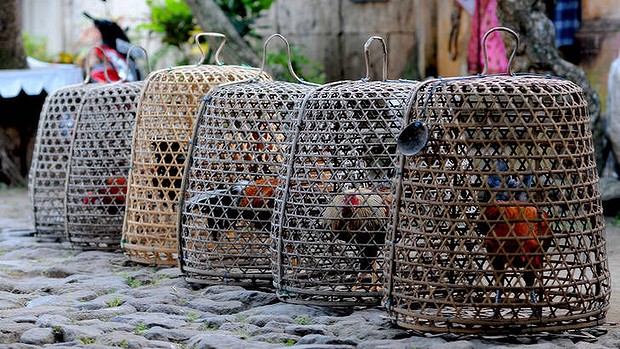
Fighting cocks ready for action.
On either side of us, field workers wearing their caping – conical hats made from leaves or grass – bend down to tend their muddy rice paddies. The fields are dotted with little shrines and Mount Batur is just visible through the haze.
The villas of Alila Villas Soori overlook either the rice paddies or face a black-sand beach, where tourists ride sedately trotting ponies. A local zips past on the wide beach, the noise of the old motorbike’s engine dwarfed by the rolling surf. It’s not a swimming beach, it’s a beach for dipping your toes, walking along and admiring from the comfort of an overstuffed sofa, with a large tropical drink in hand.
Alila is a home-grown success story, an Indonesian-owned group whose Uluwatu property has cleaned up the world’s architecture awards and a new Seminyak hotel is in the making.
We check into our villa, guided by our host Iyu, and head straight back out for a sunset dinner on a platform jutting out towards the ocean.
If you’re up for action, hunting for the next club, this is not the hotel for you. In fact, you may even rule out the entire regency.
“Why would you go to Tabanan?” a smug Ubud resident asks. “You get there, then there’s nothing to do.” I guess it depends on who you’re there with.
The hotel is buzzing with a large wedding, and darkened corners are the scene of much hand-holding and long gazes. There are also a few families with small children who are being cooed over by the staff.
The night is quiet, save for the crash of the surf, and the next morning we’re up with the sun. The full-length windows of the villa open out to the ocean and our pool, so it’s with great delight that I jump from the lounge room into the water for a frolic before breakfast is served in our cabana.
I enjoy fresh tropical juices, beautiful eggs hollandaise and, to end, a petite, perfectly chewy almond croissant with a cup of kopi luwak, Bali’s famed “civet coffee”. You know the one: Where the beans have been eaten by a small mammal, passed through their digestive tracts and popped out the other end, where they’re collected, dried and ground to make an oh, so smooth coffee. You just have to banish the idea of civet poo from your mind while you’re enjoying your cuppa.
Today, I’ll journey with the gods, through a few of Bali’s 20,000 temples (puras), with Nata as my guide. He is dressed in a white-collared shirt, a sarong over his trousers and a udeng – a cloth – knotted around his head. A woman ties a cotton sarong over my trousers, and we are declared suitably dressed to visit the temples.
Nata at Pura Timan Agung
Pura Penarukan is the main temple in the nearby village of Penarukan and, unusually, the three deities are all here – Vishnu, Brahma, Shiva: the creator, the preserver, the destroyer. We cleanse our hands with fragrant incense smoke, wave a flower through the incense and hold it in cupped hands, tearing off a small piece that we tuck behind the right ear. Three times the temple’s priest pours water into our hands, and three times we sip it, then splash a few drops on our heads. We place a few grains of uncooked rice on our forehead and at the base of our throats, where they stick as though glued, and leave an offering at a shrine.
The canang sari is an offering of fruit, flowers and food, with fire from the incense stick and water, the universal symbol of life, sprinkled on top. Rice signifies life and prosperity.
“We consider rice as a goddess,” Nata says. Dewi Sri is the goddess of rice, “padi” is the name for unhulled rice, “baras” is uncooked rice and “nasi” (think nasi goreng) is cooked rice.
“You have only one word for rice, yes?” he asks, looking at me sorrowfully. I struggle to think what we Australians have a multiplicity of words for: tax?
Back in the four-wheel-drive, we weave through the regency to five temples. It’s only the ornate stone gates that indicate where one village ends and the next one starts. The roadsides are lined with upside-down woven baskets covering roosters, ready for a bout of cock-fighting. “They’re fed a special diet of vitamins, eel, slugs, corn and beef,” Nata says.
Each village we pass has its own speciality: Penarukan for its stone and timber sculptures, Kerambitan for is its magical tektekan orchestra and 17th-century palaces that line the main road that runs through the town. Pejaten is best known for its ceramics and terracotta tiles, and the village is dominated by mountains of coconut shells, which fuel the flames to fire the tiles. The rich orange afternoon sun spills over a busy courtyard where newly pressed roof tiles are laid out on the earth.
At Kelating, the village is preparing for temple celebrations, and the local orchestra has its instruments unpacked and ready. Some gongs are more than 100 years old, their metal notes scarred and aged, and the men sit among them, cross-legged, barefoot and smoking.
If you thought Tabanan was all country roads and quiet villages, you’d be forgetting two of its biggest temples – Pura Alas Kedaton and Pura Tanah Lot – which are also two of Bali’s biggest drawcards. Alas Kedaton sits alongside a state forest dripping with monkeys. To get into the hugely popular temple, you run the gamut of souvenir-sellers who double as guides: there’s no getting around it – no guide, no go to the monkeys.
After the shops, you pass a bat show, where you can hold a furry little fruit bat by the tips of its wings, if that takes your fancy. The demo bat looks bored, and I bypass it to see the temple guardians. From every tree, dozens of sets of eyes stare out at us. Fangs, tails, eyes and limbs – all are working overtime. Tiny babies cling to their mothers while bullish teens box each other and try, with fairly serious intent, to get a leg over. They’re draped over the temple’s stupas, and scamper along its walls.
Equally mobbed by the crowds, Pura Tanah Lot, on Tabanan’s coastline, is the classic case of having been loved too well. Come sunset, it is besieged by sightseers waiting to catch the sun setting over the island temple, which is linked to the mainland by a small isthmus. The walk down to the water is fraught with decisions: Hold a snake? Eat suckling pig? Buy plastic frangipani hairclips? Spiritual, it is not.
The last stop of the day is an anathema to the crowd-pullers – it’s a simple temple five minutes’ walk along the beach from my hotel. Nata tells the story of a journeyman whose body was stolen by evil spirits on this beautiful headland. His brother built Pura Timan Agung to protect future travellers, and his descendants, from the faraway village of Pandak, still care for the pura today.
The views are every bit as dramatic as those at Tanah Lot, but we are alone on the headland. The beach ponies are in their stables, the farmers have gone home; there’s just the thunder of the surf and the call of the night birds. A black-and-white temple cloth flutters and a yellow parasol twirls as the night air rises and the little temple casts a shadow as the sun dips down over the ocean. 
The gods are resting and the south Balinese coastline disappears into the sea spray and sunset.

FAST FACTS
Getting there Garuda has a fare to Denpasar from Sydney and Melbourne for about $950 low-season return, including tax. Fly non-stop from Sydney (6hr 25min) and from Melbourne (6hr 10min); see garuda-indonesia.com. Virgin Australia and Jetstar also fly from both Sydney and Melbourne. Australians need a visa for a stay of up to 30 days; obtained on arrival for $US25 ($24).
Getting around The one-day Journey of the Gods costs $106 a person, including lunch, transport and guide, alilahotels.com.
Staying there Alila Villas Soori has 44 villas, including a 10-bedroom residence. A member of Design Hotels, it costs from $US510 plus taxes for a beach pool villa, alilahotels.com.

Belinda Jackson was a guest of Alila Villas Soori.

Read more: http://www.smh.com.au/travel/home-of-the-island-gods-20121129-2ah6w.html#ixzz2DnqbdzKF

Where the wild things are: Ubud

Gateway to heaven: Villa Alamanda

The forest is absolutely roaring tonight. Frogs croaking, crickets creeping, there’s a bird that screams like it’s on a rotisserie. Well, it could be a bird. Our driver, Gusti, describes it as a ‘little animal’. It could be the small child in our party.

This is Ubud: fertile, fecund and slightly wild. And that’s just the people. With my unerring sense of bad timing, I’ve just missed the Ubud Writer’s Festival, where John Pilger was one of the headline acts, and again, I have failed to get to one of Ubud’s legendary yoga classes. Surely, however, nothing can top the inspirational class I did with Danny Paradise, years ago, for a mere $20 at one of the neighbourhood yoga hangs. The memory sustains me.

We’ve stayed in two places in Ubud this time, the first being a private villa, Villa Alamanda, and I’ve returned to the lodge at Taro Elephant Park for the second time this year.

The four-bedroom villa is set in a small village just outside Ubud, though you wouldn’t know it. It overlooks a river ensnared in wild jungle, and the grounds include a vast infinity pool that spills down the hillside, and breakfast each morning looks out onto the wilderness.

Yet at night, I can hear plenty of chatter and the chime and clang of gamelan. This past weekend was one of the two most auspicious dates in the Balinese calender, popular for religious ceremonies including weddings, so the streets are lined with decorations and occasionally, we’ll drive through a village where the locals are dressed in their Sunday best.

The village school took the opportunity to have its new classrooms blessed, and we wandered in to witness the ceremony conducted by our villa’s head chef. The very well behaved kids, lined up watching the ceremony, had a little riot at the appearance of the curly-haired babe, but unlike my strict Mass ceremonies as a child, nobody was waiting to whack them with a cane. Perhaps that’s why Hinduism has remained so strong in Bali… 

Travel deals: 29 July 2012

TOURWATCH: Bend to pray at Kumbha Mela 2013

Surfers flex their pecs in Port Macquarie, while saints and holy men, seers and the devout bend to pray in India.

TASMANIA
Nature lovers can also be comfort lovers, especially when
we’re talking winter in Tasmania. Admire the glory of the Freycinet peninsula,
home to the perfect crescent of Wineglass Bay, from the tub. The eco-friendly
Freycinet Lodge has just refurbished its 10 premier suites, complete with new
bathrooms (and TV) earning them a 4.5-star rating. Snap up a winter special
until August 31, normally $300 a night, rooms start from $170 a night.  1800 420 155,
freycinetlodge.com.au

NEW SOUTH WALES

The Australian Surf Festival kicks off 11-26 August in
Port Macquarie, where up to 400 surfers are expected to flex the pecs as they
fight for 25 Aussie titles. There’ll also be movies, music and art exhibits
around a surf theme. Stay three nights in a 2-bedroom riverside spa cottage in
the Sundowner Tourist Park and get a free platter of local produce, a $50
voucher to blow at the Port City Bowling Club and midday checkout. Costs from
$441 for three nights, from August 1-31. 1300 303 155, portmacquarieinfo.com.au

AUSTRALIAN CAPITAL
TERRITORY

The Fireside Festival runs throughout August, with
100-mile dinners, wine and degustation dinners in 25 venues across Canberra. Stay
two nights in a King Bed superior room at the Crowne Plaza Canberra and save 20
per cent, book until August 17 and stay until September 30. Costs from $336 a
room for two nights, including breakfast. 1300 888 180, zuji.com.au

Spicers Balfour Hotel, Brisbane.
QUEENSLAND

Brisbane’s Gallery of Modern Art has pulled off yet
another major coup, currently showing masterpieces from Madrid’s Prado in its
galleries, so it’s time to head north. You’ll turn heads when you let drop
you’re staying in one of the town’s hippest little hotels, the nine-room Spicers
Balfour Hotel. Set 3km from the CBD in funky New Farm, book 14 days ahead and save
$60 a night. Includes breakfast, canapés in the rooftop bar and wi-fi. Costs
from $299 a room. 1300 597 540, spicersgroup.com.au.

VICTORIA

Pull on your walking boots for a spring trek along
Victoria’s south-west coast and save $110 when you book the Great South West
Walk (22-25 Sept) and Great Ocean Walk (27-30 Sept).  Carrying just your day pack, the guided walk
follows well-maintained trails and includes a night in Cape Otway lighthouse
and lunch with the 12 Apostles as a backdrop. Both trips depart from Melbourne
and groups are limited to 14 people. Costs $2190 a person. (03) 9877 9540,
parktrek.com.

WESTERN AUSTRALIA & NORTHERN TERRITORY
Katherine Gorge

See the best of the west, from Perth to Darwin, over 18
days, visiting some of the world’s greatest beauty spots: Ningaloo Reef, the
windswept limestone formations of the Pinnacles and the gorgeous gorges of the
Territory. There’s a touch of luxe, too, at Cable Beach Club Resort in Broome,
and El Questro Wilderness Park. Save $650 on coach tours departing September 6
and 29 and October 18. Costs $6345 a person. 1300 805 493, travelmarvel.com.au.

FIJI
Zipping in from the remote islands and need a pad to hole
up for the night? Or want to get to grips with the street markets of Nadi, the
Novotel Nadi and Mercure Nadi are knocking 20 percent off their room rates for
two-night stays. Includes free airport transfers, on stays until January 31.
Costs from $87 a night (Novotel) and $70 a night (Mercure). 1300 656565, accorhotels.com

FRANCE
Wander the medieval cobbled streets of the rue du
Faubourg St-Antoine on the Right Bank, for a slice of Parisian life. Stay four
nights, pay three at the three-star Le Patio St Antoine when you book and
travel before August 31. Includes breakfast daily, costs $321 a person, twin
share. 1300 747 400, creativeholidays.com.

CUBA
It’s a country with one of the coolest soundtracks… aaah,
Cuba, you’re hip to the eyeballs. This tour covers the length of the country,
from Havana in the west to the old pirate haven of Baracoa in the far east,
with stops for the Che Guevara museum, Trinidad’s beaches and some sultry salsa
in Santiago de Cuba. Book by August 27 to for September 1 departure and
save $456 a person. Costs $1369 a person, 15 days. 1300 018 8701, intrepidtravel.com
.

South Luangwa game drive, Zambia

ZAMBIA
There are just seven safari tents at Sanctuary Puku
Ridge, which treat lightly on the earth of the South Luangwa National Park.
Watch the sun rise from your bed, and animals gathering at the waterhole near
your tent. Stay three nights and save more than $1700 a couple, including all
meals, drinks, game viewing and flights from Lusaka. Costs $2120 a person, twin
share, until October 31. 1300 195 873, benchinternational.com.au

ALASKA & CANADA
The fish are
seriously big on Alaska’s Kenai peninsula, as are the bears. It’s Alaska’s wild
playground. Discover it in 5-star style, o a 28-day journey from Canada up to
the Arctic Circle, including seven nights cruising the Alaskan coastline,
slipping between the icebergs of Glacier Bay National Park. Couples booking before
October 19 will get one free return flight to Canada. Costs from $16,010 a
person, twin share, which includes flights for the second person travelling.  1300 723 642, scenictours.com.au. 

TOURWATCH
Saints and holy men, seers and the devout: watch the
swirl of humanity as India bends to pray at Kumbha Mela, one of the world’s
largest pilgrimages. In January and February 2013, up to 60 million people will
gather in Allahabad, in the Uttar Pradesh, at the confluence of point
Hinduism’s three holiest rivers – the Ganges, the Yamuna and the ethereal Saraswati.
Devotees stretch 15km along the riverbanks on auspicious bathing days to
cleanse themselves of sin. This eight-day tour starts in Delhi and warms to the
religious theme with a visit to the holy city of Varanasi, south of Delhi,
before continuing to Allahabad, where you’ll stay in a tented camp in the heart
of the action. Costs from US$809 (A$780) a person. Unique Tourism, (02) 921
6590.

Source: Belinda Jackson, Sun Herald newspaper

Travel guide to Dublin

Ta-daaaaaaaaaah! It’s Dublin. Hopefully all you need to know (and some you didn’t). But try to squish a city into two pages, and there’ll be some casualties.

Click here to get the lowdown. Slainte!

Cow pats and incense

“Why is it that every foreigner goes to Varanasi?” a well-travelled Delhi local asked me. At the time, I was in the car going to the airport.

“Beats me, I’ll let you know when I get there.”

I have decided it’s not the cow pats, slammed on narrow alley walls to dry then stacked in elegant, symmetrical  towers and burnt in place of expensive firewood. Nor is it the heaving, polluted streets clogged with bicycles, pedal rickshaws, auto rickshaws, cars, 4WDs and trucks, all leaning on their horns.

I have decided it’s the half-naked sadhus, with their crazy eyes, saffron-coloured loincloths, their matted hair and beards, the ropes of beads around their necks and the little metal tridents they carry signifying the three main deities of Hinduism.

This morning, after watching the sunrise prayers along the riverbed, I was having a cup of tea sitting alongside a few old buggers and Lalla, who was desperately trying to get me to visit his uncle’s silk shop, when two picturesque old sadhus approached me, offering a photo in exchange for money. The old men booed them till they left.

“They’re not sadhus,” Lalla translated for me. “The men are saying they are just dressing up to get the tourists’ money, which they spend on alcohol at night.”

Such devout Hindus as sadhus don’t beg for money, Lalla added, and they sure don’t drink.

But it just proves: you can be whoever you want to be here: you can cast off your old identity and create a new one – want to walk around in a sarong, barefoot with tingling ankle bells at your every step? Tattoo, pierce, go rogue? Don a sari or pashmina and live out Jemima-Khan-style beautiful-veiled-woman fantasies? Clad head to toe in army fatigues, PLO scarf and jasmine necklaces? Grow your hair long, learn Sanskrit and yoga and dub yourself His or Her Holiness? In Varanasi, it’s all possible, and the show is playing 24/7/365.

Cows and holy men: Varanasi

“You haven’t been to India until you’ve been to Varanasi,” a well-heeled woman told me last week. “After that, everything is India Lite.”

Varanasi is India’s most holy city. Lord Shiva looked out from the highest peak in the Himalayas and chose this spot to be his. It’s the city of Shiva, the city of light, it’s where the sacred Ganges flows and the aged wait here to die in a place of holiness and purity.

“If you want to see the city, you have to see it with the heart and the eye,” says Anub, a local. “No-one is bigger than religion or belief.”

Six hours later: I’ve floated a tiny boat of flowers and a candle down the river, seen sadhus (religious men) stripped almost naked and plunging in the water, seen the flames of a distant cremation and watched as even Indians do a double take at the sight of a young, fair western boy dressed as a holy man in a dhoti (think Ghandi’s shawl) and dreadlocks.

Boatmen offer to row you out into the broad river for a few dollars, but tonight was a night of walking for me. Until I stopped for chai on the stairs and someone pointed out something beside my hand. A monster! I jumped, dropped my camera and cracked the protection cover. Lucky it wasn’t the lens. Hmm. Maybe I’ve photographed something I shouldn’t. This town’s all about karma, you know. and washing in the Ganges is supposed to be the cure. However, the water of the Ganges is a dull olive-green. And it doesn’t smell so good. I dabble my feet in it and sprinkle it over my hair, but as for leaping in, like the young boys this evening, maybe not.

Ganeesh, the blue boy-cum-elephant, is painted on the walls of the crumbling mansions that line the Ganges, alongside advertisements for restaurants, hotels and tea shops. The crowds gather at the main ghat (stairs that lead into the river) for evening puja, a celebration led by a chanter and supplicants dressed in robes the same vivid yellow as the marigolds they were scattering across the holy water.

The streets are intense. No cars or auto rickshaws are allowed a half-kilometre to the river, so great is the congestion. So pedal rickshaws compete for space with mopeds and motorbikes, bicycles, us pedestrians and the cows, which plod expressionlessly through the traffic, waiting their turn and negotiating the roundabouts with skill.

It is all winding down as I leave around 9.30pm but the party starts all over again tomorrow morning at 5am, in time for sunrise prayers…

Global Salsa

Well, you’ve scrolled this far. What do you think? Drop me a line, I’d love to hear from you.

Privacy Settings
We use cookies to enhance your experience while using our website. If you are using our Services via a browser you can restrict, block or remove cookies through your web browser settings. We also use content and scripts from third parties that may use tracking technologies. You can selectively provide your consent below to allow such third party embeds. For complete information about the cookies we use, data we collect and how we process them, please check our Privacy Policy
Youtube
Consent to display content from - Youtube
Vimeo
Consent to display content from - Vimeo
Google Maps
Consent to display content from - Google