I’m a journalist, travel writer, editor and copywriter based in Melbourne, Australia. I write pacy travel features, edit edifying websites and fashion flamboyant copy. My articles and photographs have appeared in publications worldwide, from inflight to interior design: I’ve visited every continent, and have lived in three. Want to work together? Drop me a line… 

Follow


Divine intervention: don’t kill your television

What’s on Indian TV tonight? Veging out to Cory Feldman killing vampires, I flick the channel to find lots of ads for Fair & Lovely face-bleaching creams, news of the death of an Australian cricketer in Adelaide at 94, the Bollywood hunk Salman Khan shooting people in his new movie and advertising washing powder, and I meet the (quite possibly self-proclaimed) Father of Indian Healing, an obese man with a fondness of red caftans and lots of beads.

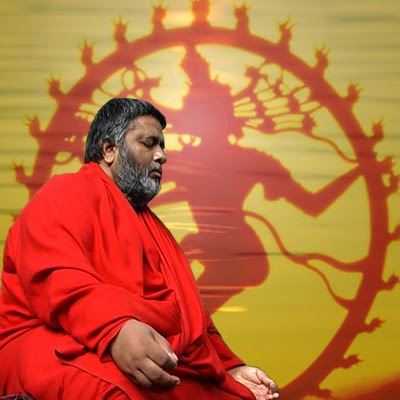
His Holiness Avdhoot Baba Shivanand Ji, the Father of Indian Healing, has a body of an enormous balloon and his face bobs as he plays videos of happy converts telling of their life’s successes to enormous halls of listeners. Preaching Shiv Yoga, he chats with pictures of divinities superimpose above his head and phone number and website, (oh, ok, it’s www.shivyog.com if you’re really interested, and I don’t take commission), flashing in between.
It answers an interesting question I’ve been asking to whoever’ll listen (and hey, guides and hotel staff are paid to listen, the poor buggers). The question is: do Indians do yoga and meditation? Sunny-tempered Ajitabh said he was taught a few moves once, and really should get back to it. But resentful Anob says Indians have no time for such luxuries as meditation retreats: “we are all too busy working”. Join the western world, my friend. But a fellow train passenger today, who hails from the western meditation epicentre of Pune, says yes they do.

While such places as Dharamsala and Rishikesh (where the Beatles famously discovered pot, sitars and their own mantras) cater almost exclusively for westerners, the Father of Indian Healing shows Indians are not immune to the lure of evangelism.

In what has to be the world’s longest TV advertorial, the super-sized Pratiprasav Sadhna is advertising a powerful method to heal fears and phobias, to release unresolved issues of life and receive the grace of Great Lord Shiv-Shiva, himself (ie the Father of Spiritual Healing) and his sidekick, a handsome young Spiritual Master. The all-Indian crowd in front of him appears to be rapt as he promises to release past life karmas, to make your life healthier and happier. Interested?

Singh is King

And so the formula goes: every Sikh is a Singh, but not every Singh is a Sikh.

Dharamasala is behind us as we gun it down to the plains of the Punjabi and the city of Amritsar. Just a few hours after coming down from the mountains, the air is hot and dry.

Tibetan caps have been replaced with turbans, or paghi, and patkas, the black stocking-like headcovers worn by observant Sikh men to keep their untrimmed hair in check. While only 4.5% of India’s total population is Sikh, they make up about half the Punjabi state, and the town of Amritsar is famous not only for its fish tikka, leather shoes and the invention of the pappadum – all excellent things, I’m sure you’ll agree – but also for the most holy of Sikh temples, the Golden Temple.

Shades of Borneo the other week, the domes are covered in 400kg of 24-carat gold and every morning and every night, the sacred text of Sikhs, considered a living god, is woken up and put to bed via a palanquin garnished with garlands of fresh roses and marigolds in great pomp that draws up to 10,000 visitors in one day alone.

Harpreet, a local Sikh, took me round the temple, visiting the massive kitchen full of cauldrons of dhal and a chapatti machine that can churn out 30,000 cooked chapattis an hour. Yes, an hour. Not bad when the average man eats four or five rounds of the bread at each sitting. The 24-hour kitchen, run by a small staff and an army of volunteers, feeds up to 40,000 people every day. Every. Day. Every Sikh temple offers the same service to all comers regardless of religion: which is surely welcome considering the World Bank estimates that 80% of India – that’s 800 million people – earn less than $2 a day.

Lots of men were taking a dip in the waters that surround the temple, and I was reminded of the phrase from the former JJJ reporter Sarah MacDonald’s awesome Indian travelogue, ‘Holy Cow’ that Indians can ‘look without seeing’. Moving on…

Of yak butter, tantric meditation and why I’m not a supermodel…

Walking through the streets of Dharamsala is like walking through a Benetton ad: you can see the broad Central Asian faces of Tibetan exiles, narrow, dark faces from southern India, pink skin and pale hair of sunburnt western European tourists and the placid Nepalese influence all jumbled into India’s mix.

The menus are equally pan-global: chow mein, mutton curry and fried eggs all on the one menu.Will I the only foriegner to gain weight in India??? My plans to lose the cruise ship’s generous bestowal of a second backside have been, to date, thwarted by India’s lush fried breads – parantha, roti, chapatti, poori, naan…

Last night, I ate at a little Tibetan restaurant, where butter tea was on the menu.

“We put tea, water, salt and yak butter in the tea,” explained the waiter happily. Then his face then fell. “But there are no yaks here in Dharamsala, so we use Indian butter. You have yaks in your country?” Not as far as I know, I confessed. I watched him mentally scratch Australia from his list of desired alternative residences.

Higher on the mountain, north of Dharamsala, is McLeodganj, the English-established hilltown that’s the home of the Dalai Lama’s monastery in exile. Three narrow streets link the main square with the temple, and are crammed with shops selling everything from Tibetan dresses to tailors whipping up clothes on the spot, pretty junky jewellery, prayer bowls, as well as espresso.

It is a mark of the town’s tearaway prosperity that it is absolutely jam-packed with espresso cafes, heavily patronised by groovy backpackers regaling each other with wild tales of hairy adventures and narrow escapes, and Buddhist monks texting each other over lattes.

Yoga retreats and meditation ashrams line every corner, cheap guesthouses offer sagging beds for $4 a night, while flashier options are springing up daily, but still charging no more than $15 with views of the towering Himalayan mountain range, Dhamladhar, along with breakfast: fried eggs…fried Indian breads… Despite the absolutely perfect high 20s temperatures, the town is not in peak season. That comes in the next month or two, when it really hots up.

Although I’m not bald and also sans dreadlocks, I stuck my nose in to the new meditation ashram presenting the teachings of controversial guru Osho, and listened to a long-winded lecture about how I must worship the Divine Mother, the world-famous Her Holiness Shri Mataji Nirmala Devi, who also teaches meditation (but for a lot less money than Osho’s mob).

I enjoyed the calmness of HH’s ashram and the sensibility of meditation, but all calm was lost as her devotee refused to pause for breath while telling of miracles across the world, and did that annoying thing of pointing out a deity’s face as appearing in a natural formation: this time in a cloud formation over Australia’s Thredbo village, where she has visited and spoken. Hello, has ANYONE heard of PhotoShop in this town?

Because you asked…

Well it’s been three weeks since I hit home after almost a year in Egypt. There’s a definite pattern in the questions I’ve been asked since I’ve been back, so let me run you through the answers (I probably should have done this weeks ago, which would have saved me sounding like a parrot).

Did you wear a headscarf? No. I’m Christian and I’m foreign. People don’t expect me to cover my hair. However, I did cover my knees and usually upper arms. Having said all that, in the chic nightclubs and private beaches, anything goes, from belly button rings to crop tops and miniskirts.

Were you scared living in Egypt as a lone woman? No. Cairo is an incredibly safe city. Like any place, there are some areas you don’t want to go (and not just women, but men, too!) – such as super-poor districts – but to get there, you’d really have to work hard: either take a cab or coax someone into to driving you. Hordes of drunks cruising the streets causing havoc are unheard of in Cairo. In fact, I attribute a large part of Cairo’s safety to the lack of alcohol in the country. Which brings me to the next question…

Could you drink alcohol? See Answer 1. Christian and foreign means alcohol is fine. However, wandering around drunk is very poor form. Some waiters were uncomfortable with serving women alcohol, but I am not quite sure why they were working in such establishments if they felt this way. Compared to average consumption in Australia, it was all severely curtailed. The local wine, friends, was generally dreadful, but alcopops, spirits and beer are in easy reach…24-hour delivery, if you really need it.

And what about pork? I think when you travel to places with different diets to your own, you either (a) obsess about the food you can’t eat – think Australians’ obsession with the thick, black, salty paste called Vegemite that we slather on our toast – or (b) you just forget about it. There was some pork floating around Cairo – most notably at the Italian Club and in an Italian-style café in Zamalek, but after Egypt knocked off all its pigs, ostensibly to prevent swine flu, neither love nor money would get you a slab of bacon. However, there were rumours going around the expat network recently there was a guy in Alexandria…

Work or holiday? Well, since my rich great-aunt died, I have spent my life on cruise ships and safari, without needing to work. That was sarcasm. Yes of course I worked, but Egypt being a far less expensive country to live in compared with Australia (no car registration, insurance, overpriced taxis and cheap, fresh food) meant I didn’t have to chain myself to a desk five days a week, and could instead travel to surrounding countries which I’m still publishing the stories for.

Did you learn any Arabic? Yes. Well, it was either learn Arabic or spend a year doing Marcel Marceau mime impersonations. While plenty of Egyptians told me I didn’t need to learn any Arabic, they are obviously delusional as to how much English is actually spoken in Egypt. And I think it’s pretty shoddy if you can’t at least say thanks. Also, if you can’t count, you’re just leaving yourself open to being fleeced (a nice way of saying ‘ripped off’).

So… were you fleeced? Of course. But then Egyptians are an indiscriminate bunch, and will try the same tricks on their fellow Egyptians. It’s just that as a foreigner, I’m obviously insanely wealthy and therefore fair game. The more Arabic I spoke, the less it happened.

Any essential travel things you would never go to Egypt without? An enormous cotton scarf. I bought an awesome one in Cairo and, as I’ve mentioned elsewhere, it has worked as a headscarf when entering mosques, to wrap up in freezing planes and um…. as an emergency towel. And Lonely Planet’s fantastic Egyptian phrasebook. I carried it every day. It is still recuperating from its year-long workout.

And finally, do you miss Egypt? Cairo’s a dirty, crazy city of 20 million people. The pollution is ridiculous, the noise intense, and you can stick out your finger and poke the energy. I miss it every day.

Muslim-Christian violence rents Upper Egyptian town

The southern Egyptian town of Naga Hammadi will never be the same again. The past week has seen the town, 60km north of Luxor, turn into a battleground of sectarian violence that has shocked the nation when seven young Christian deacons were murdered in a drive-by shooting on the Coptic Christmas eve. Also killed was a Muslim church guard.

Three Muslim men have been arrested over the murders, which it is reported were in retaliation for the alleged rape of a 12-year-old Muslim girl by a Christian man, in November.

Eyewitness reports state that 10 Christian deacons and the Muslim man were gunned down outside Mar Yohana church on the eve of the Coptic Christmas, on 6 January, as they left the ceremony. Six died at the scene, the seventh later in hospital.

Violence has spread to other southern Egyptian cities which have seen houses and businesses being torched by rioting crowds, which police have counteracted with tear gas and rubber bullets fired into the crowds.

Commentators say there is more to this than meets the eye: the man  accused of the rape did not automatically receive the mandatory punishment, which, in Egypt, is death by hanging. Instead, his case was referred to a higher court, which opponents say is the government protecting its minority Christian population. It begs the question: is the government guilty of protection or could there be doubt the man is actually guilty?

Egypt has been home to Christians since the first century and approximately 10 percent of Egypt’s 83-million strong population is Coptic Christian.

NB: this page will be updated in the coming day.

What you didn’t know about Jordan..


The Dead Sea is 400 meters below sea level, the lowest point on earth.

Jordanian wine is actually very palatable.

Cheap labour comes from Egyptians.

In winter, racing camels are rugged up with a poncho with a hole cut out for the hump to slip through.

Jordan is actually the Hashemite Kingdom of Jordan, ruled by King Abdullah.

King Abdullah II’s father looked like Sean Connery and his son like Harry Potter. The king’s mother is Scottish.

Lawrence of Arabia lived in Wadi Rum, in southern Jordan..

A donkey can set you back US$500.

The Dead Sea is oily.

Quick biblical facts on events in Jordan:

Jesus was baptised.

John the Baptist was decapitated.

Lot’s wife turned into a pillar of salt, and still stands.

Moses died.

Salome danced the dance of the Seven Veils in front of King Herod.

And finallly, if you were looking for it, Jordan is the site of the original Sin City, Sodom & Gomorrah.

Jordan: of magic and the ownership of miracles

“And this is where Jesus was baptised,” said the guide, pointing at a dry riverbed. The empty creek is an arm of the River Jordan. From our position in the far west of Jordan, we could see the skyline of Jericho, and later, when the sun went down, the lights of Jerusalem.

A short walk along a tree-lined path took us to the river proper, the natural border between Jordan and Israel and Palestine. I splashed cool water at Israel and admired the new buildings on the opposite side of the river. The baptismal site of Jesus is recorded in the Bible, in mosaics on the floor of the ancient church by the site and from writings by travellers of the day. However, there are some who maintain that the baptismal site is actually on the other side of the river, on the Israeli side. The guide told me there is, in fact, only one country making the allegations. Sure you can work it out.

Today, we also wandered around the fabulous citadel that rests on one of the seven hills of Amman. It’s suggested the Roman temple was dedicated to Hercules, the find of a massive clenched fist amongst the excavated rubble being a dead giveaway. Fingers the size of an average-sized Jordanian woman.

In Madaba, I visited the Basilica of St George to see its world-famous mosaic floor, featuring a map of the world at the time. The resident guide talked me through it all: Egypt here, Bethlehem there, Jerusalem up a bit…

“It’s an historical map, not a geographic map,” said the guide mildly when I queried the fact that Egypt was on the wrong side of the Red Sea. Moses was lost for 40 years on the Sinai peninsula, it would have been longer if he was using this map.

Speaking of Moses, the man who led his people to the Promised Land featured prominently today, as I walked up Mt Nebo, where he died and ascended into Heaven – no body was ever found.

I’m going to go into a bit of religious theory here, so hang on: one of the fundamentals of Islam is the belief in the prophets, of which there were many, and Moses (or Musa in Arabic) is one of the biggies. So, implicit in the religion is the belief he spent four decades lost in the wilderness, had a hotline to God and shot up to heaven when his time was up.

“Sure I believe,” said a devout friend of mine recently. “It was a time of magic on earth, but that time has ended.”

And so ends my first day in Jordan. Tomorrow: hopefully shimmy past Sodom & Gomorrah, the ruins of Petra and, if I’m up early, a wallow in Dead Sea mud.

Watching the movies, watching the moviegoers

My ears are still doing that weird void of silence things after an assault in the cinema at Cairo’s glamour mall, City Stars. I know Egypt has only two levels of volume: off and 10 and like the rest of the region, love nothing more than a good blast of polar-strength air-con. Loud and cold is probably not the best environment to enjoy a movie, though, especially the three-hour doomsday saga of 2010.

As interesting as the movie were the clientele: being the holiday period of Eid, Cairo is once again full of holidaying Arab guys (that’s Saudi Arabians, for you and me) with their long hair and fat wallets. Also, one of our gang was shocked to see a munaqqabah in the cinema. The niqab is the all-encompassing dress some women wear that leave only their eyes visible, and lately I’ve been noticing women on the metro who go the final step and have a piece of black gauze over their eyes so they can see out but you can’t see in.

What’s so weird about a woman wearing the niqab in the cinema? I asked, only to be reminded that many in this super-conservative group consider movies and music to be haram, or against Islam.

Recently, the imam of Al-Azhar mosque, the esteemed seat of Islamic learning, banned the niqab from female-only classrooms in the mosque’s schools, secondary schools and university institutions. The debate amongst bloggers is raging.

I don’t know a lot about it: I do know women wearing the niqab aren’t so keen to sit beside the obviously non-Muslim foriegner, though I had a chat with a nice young munaqqabah last week on the train. Locals can’t understand my fascination with the topic, but I maintain that what people don’t understand, they fear. And in a time when the world is in religious upheaval, understanding and appreciation are the only ways toward acceptance and tolerance.

(Pic credit: Bikyamisr)

The night before Eid

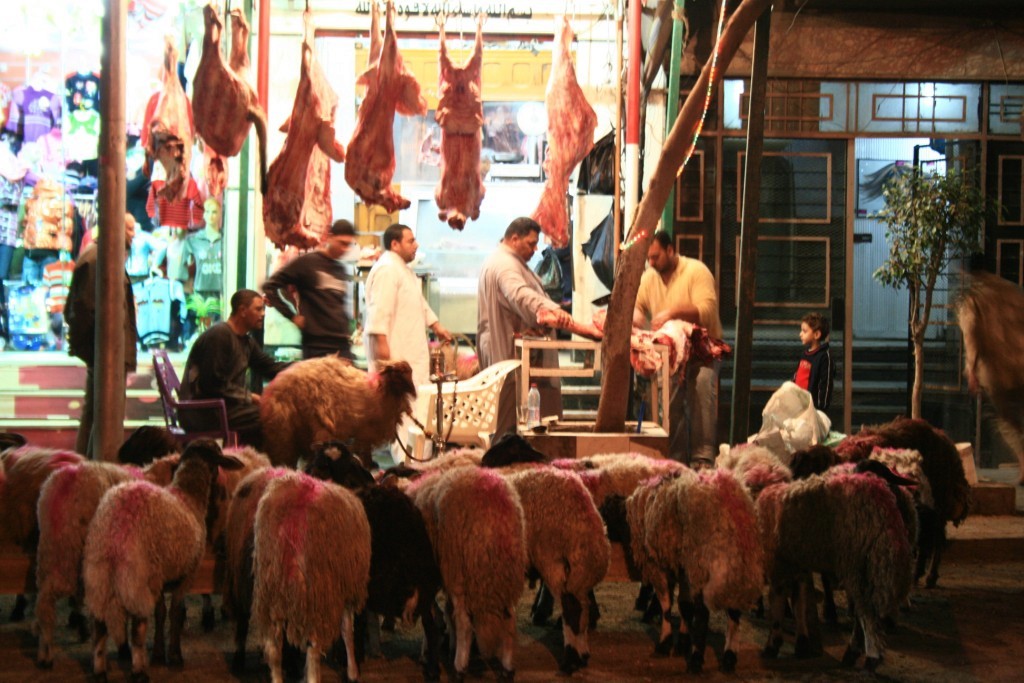
The streets are filled with sheep and the occasional cow in the last days before Eid, the Feast of the Sacrifice. The sheep have been set into makeshift pens and are guarded day and night by a shepherd. They are going for LE1500, or about A$300 each. That means there’s a whole lotta cash messing up the roads here in Cairo

However, it seems that not theft, but small children are the issue most concerning the shepherds. Kids are hanging delightedly around the sheep, trying to wrestle their long horns and ride them the minute the shepherds’ backs are turned. The guys have big sticks they wave at the kids, who fall back slippery as eels, then resettle around the pens, totally uncatchable, laughing and jeering.

It makes logistical sense, but it’s also a bit grim that the sheep are living outside the butchers, snacking cheerfully from wooden troughs. Above them hang the carcasses of their peers but being sheep, they don’t seem to have made the connection. Or perhaps they’re in denial.

Today, Egyptians fasted on the last day before Eid, then the sacrificing begins after prayers at sunrise tomorrow morning.

I took pix down the street last night, got mobbed by about 20 kids, and the old market women who kill the rabbits and pigeons for a living were shouting in the street, “Our cow’s getting photographed by Australia!” I also snapped two happy bakers with one of the huge mountains of bread on the street that tomorrow will become part of fattah, the traditional Egyptian dish of rice, fried bread and meat that I’ve eaten slathered with garlicky mayonnaise.

For the four-day holiday, I’m skipping out to the desert oasis of Siwa with a bunch of friends-to-be, 50km shy of the Libyan border, on the edge of the Great Sand Sea. Land of sand dunes, palm gardens, hot water springs and those weirdly giant plastic date palms that are actually mobile phone towers. Kul sanaa wento tayebeen (Best wishes to all)!

Animal kingdom visits Cairo

Cairo is gearing up for Eid. Last night, as I closed my windows, I heard the familiar sounds of geese disturbed in their sleep, the rooster trying out his pre-dawn lungs and a new sound, the baa-ing of sheep. This is in central Cairo.

Farmers are bringing in their livestock to sell for slaughter during Eid al-Adha, the feast of the sacrifice. The other day, in Gamaliya (Islamic Cairo), a man was whistling a herd of sheep through the main thoroughfare of el-Muiezz. Then I rounded a corner and nearly took out a large cow, one of those mournful Egyptian cows with skinny legs, huge ears and the saddest face that would break your heart.

Walking back from the fruit & veg market, my street has suddenly sprouted several sheep pens with brown shaggy, horned animals milling about, and the sidelanes are like a scene from Animal Farm.

Thursday. It all starts Thursday.

Global Salsa

Well, you’ve scrolled this far. What do you think? Drop me a line, I’d love to hear from you.

Privacy Settings
We use cookies to enhance your experience while using our website. If you are using our Services via a browser you can restrict, block or remove cookies through your web browser settings. We also use content and scripts from third parties that may use tracking technologies. You can selectively provide your consent below to allow such third party embeds. For complete information about the cookies we use, data we collect and how we process them, please check our Privacy Policy
Youtube
Consent to display content from - Youtube
Vimeo
Consent to display content from - Vimeo
Google Maps
Consent to display content from - Google