I’m a journalist, travel writer, editor and copywriter based in Melbourne, Australia. I write pacy travel features, edit edifying websites and fashion flamboyant copy. My articles and photographs have appeared in publications worldwide, from inflight to interior design: I’ve visited every continent, and have lived in three. Want to work together? Drop me a line… 

Follow


Positions vacant: wanted, one military dictator

The discussion over who will suceed President Hosny Mubarak, now 81,  is reaching fever pitch, even in such far-flung corners as Australia. Take a look at this article appearing in today’s Sydney Morning Herald. For sure, the accompanying photo, a picture of Hosny with the Star of David on his forehead, and a pair of feet stepping on the photo, would never be published here in Egypt (this pic is one the many propaganda snaps across the country, where Hosny does his Blues Brothers impersonation).

Yes, the man who has singlehandedly kept Egypt’s black hair dye companies in business is getting his house in order.

Of course, rumours of Hosny’s ill-health have been running for years: he’s an old man. But with the blatant grooming of his son Gamal, the whole country is obsessed with the question: what will come of the elections, to be held next year?

The criteria for eligible candidates appears to be tightened by the day, as critics say Hosny’s men are erecting yet more and more barriers to exclude undesirable candidates (internationally respected scholars and diplomats, that sort of  nasty type), and posters of Gamal and his dad (aka “La Vache qui rit” or the Laughing Cow) have been popping up all over the countryside. Mind you, Gamal doesn’t endear himself when a soujourn up to his villa on Egypt’s Mediterranean coast means more roadside checks and police blocks than you can shake a passport at.

In the Australian article, a commentator states, ”The Mubarak family is not a dynasty. They are a father, a mother and two children.” In fact, a neighbour pointed out to me recently that he used to live just down the road from me in a decidedly unremarkable suburb (as opposed to the palace next door, which like most of Egypt’s palaces, is a lush affair that the public will never set foot in, even tho it lies unused, just a massive dust collector).

The other key point in the article is the $1.7 billion aid Egypt receives from the US every year, no doubt to placate and keep sedated the existing government. Who knows where the money goes? In my recent jaunt up on the north coast, I spotted numerous watchhouses where bored young conscripts perfect their 1000-yard stare, doing little but collecting water on donkeys and watching goats wander past. The watchhouses are ramshackle affairs covered in wire and tattered flags, not exactly awe or fear-inspiring.

For sure the money is not going to that side of the country, not even at the raw western border town of Sollum, which butts up against Libya. Hey, what about that steel wall being built between Egypt and Palestine, on the eastern front? Worth some questions…

http://www.smh.com.au/world/life-after-mubaraks-iron-rule-egypt-faces-uncertain-future-20100110-m0ti.html

Reasons why not to drink in Egypt

Surely this pic is enough?

Snapped in a shopfront in Downtown Cairo, Fenilad Fodka and imitation Johnny Walker whisky, though my favourite is still the ‘Johnny Walking’ brand.

They’re marked at 40% alcohol, but there’s some watering going on here.

Makes abstinence in Egypt that much easier, don’t you think?

A budget tip for the Giza Pyramids

We were prancing around the Pyramids the other day (as you do) and went inside for a look: it’s been a year since I went inside the tombs, preferring to observe from a distance on horseback.

The entrance fee for foriegners is currently sitting at LE60 (about A$12) with a further LE120 (A$23.50) if you want to climb down into the burial chambers of the Great Pyramid of Khufu, which winds 30 meters deep into the Giza plateau.

Otherwise, the slightly smaller Pyramid of Khafre is an option, in summer a claustrophobic sauna as you climb down wooden rungs on the sloping ground into the bowels of the earth.

So here’s my Egypt budget tip for the day (apart from masquerading as an Egyptian, with tickets for locals sitting at LE3): we visited the smaller pyramids behind Khufu, that of Queen Hetepheres (2551 – 2528BC) and, interestingly, that of her engineer.

The engineer knew what he was doing: while all the others are stripped of any sustained decoration, his works are a riot of carvings and colours not seen in the others I’ve visited. And it’s free, apart from the usual couple of pounds’ baksheesh to the guys out the front. Don’t worry, they’ll make sure they’re around when you come back out.

It’s a great way to get a quick Pharonic hit if you’re not going down to Luxor or Aswan, and you dozed off in the Egyptian Museum.

I’m on the road and have left my camera cable at home, but I’ll pop up a few pix when I’m back in a couple of days. Cheerio!

Sultans of Bling

Most people visit Cairo for the Pyramids at Giza, Sakkara and Dashur. Many do it also for the medieval mosques in Islamic Cairo. But Cairo as a shopper’s paradise like Hong Kong or Bangkok? Not quite.

However, we’ve spent the past couple of days exploring the underbelly of Cairo’s gold traders, in search of a wedding ring (no, not mine!) Jewellery is dictated by fashion, make no mistake. And the fashion at the moment in Egypt is for Seriously Big Bling.

So when Fee turned up in town with her little, white hands and a taste for the understated, it became immediately obvious we were in for a rough time. We visited the gold strip in Misr el Gedida (Heliopolis) near Midan Salah El Din, and also the gold traders of Khan al-Khalili and Sharia El Muizz.

The shops ranged from luxe emporiums to tatty offices where dealers pulled trays of diamonds out of secret compartments behind their knees and talked about the colour H and vvsi grades of clarity, princess cuts and claw settings. It was a learning curve for both of us.

We weren’t the only shoppers. While a few Christmas tourists poked their noses into the shops, Egyptian buyers were busy poring over the trays of gold, lured by enormous diamonds and rich yellow, 18-carat extravaganzas. None of Australia’s pale, limp 9-carat wanna-be gold.

Interestingly, it’s the ladies who wear the most gold in these parts. The precious metal is considered to be detrimental to men’s health, so most men wear a silver wedding ring. I’m ok with that. With gold prices at an all-time high as investors seek safe investments, grooms get off pretty cheaply. Not like the brides.

Rings ranged from pretty little trinkets from young men to their intended bride to no-holds-barred golden knuckle dusters that have you dragging your hands on the ground under their weight.

The main thoroughfare of El Muizz is lined with gold and silver shops (not to mention other businesses selling lanterns, plaster busts of Nefertari, pyramid fridge magnets, inlaid chess boards, chandeliers, tatty jewellery and a never-ending stream of tassle-laden shisha pipes). All through the night the cobbled street rang with the sounds of the zaghroota, the elated wail that Arabic women do when they’re celebrating. Weddings especially.

“It can make a man’s blood rise,” an old man confided to me once.

“What’s that woman screaming for?” asked a concerned Fee. Different ears, different interpretations.

Fifteen shops and three shopping sessions later, we have found the ring (a sweeping solitaire), negotiated the price (of course, more than the original budget) and organised for the resizing. The bling, my friends, is in the bag.

PS: If you’re jewellery shopping in Cairo and want some contacts, we had success finding the ring at the dusty, seemingly empty Ahmed Hosny & Sons at 99 Sharia El Muizz and are getting work and diamond done at the lovely Gouzlan, beside Naguib Mafouz restaurant in the heart of Khan al-Khalili.

Christmas in Cairo

It just doesn’t feel like Christmas here in Cairo.

No matter how many plump plaster-cast reindeers and glitzy gold Christmas trees in the mall.

No matter how many boys selling Santa hats (including a frightening,’Silence-of-the-Lambs’-style with an eyeless, flayed rubber Santa face hanging below the fringe.

No matter how many times Nile FM can play Wham’s ‘Last Christmas’.

It’s not surprising considering Egypt’s Coptic Christians celebrate Christmas on 7 January.

My one and only work Christmas party was put off till 15 January, however, we made a good fist of it, helped by the fact Christmas Eve is on a Thursday, the Arabic equivalent of a Friday night. So we crashed the Christmas party at the pumping bar, After Eight (reached by walking off the street, through a kiosk selling chocolates and chips then down an alleyway that has actually been cleaned up).

The entertainment was a band, two DJs and they also threw in a beautiful belly dancer who had a gorgeous smile but was lacking in the whole hip movement area. The first DJ belted out a fistful of fun Arabic pop, but the second went into deep, heavy dance that lost the holiday bonhomie as well as the dance crowds.

There was no fowl on the Christmas table (Fee objects) and no pork either (Egypt objects, and has killed all its pigs in a frenzy over swine flu). Thank god, there is always smoked salmon…

The plight of the pigeon

The first time I looked up, properly looked up, in medieval Cairo, I noticed weird wooden towers built on the top of apartment blocks. “What are they?” I asked the old man showing me the view from a mosque in Cairo’s City of the Dead. “Hammams”, he said. “Bathrooms?” I thought. How weird! People climb up those rickety little ladders to go to the toilet? “Hammans?” I asked, just to be sure. Yes, yes, he nodded. “Hammams.” What I later discover in the great game that is learning Egyptian is that a hammam is a bathroom, but a hammam…is also a pigeon. Something to do with more or less ‘m’ pronunciation. Yes, winged rats despised by the Anglo world, scourge of European monuments. Yet all over Egypt, these little boxes on stilts are where one of Egypt’s great delicacies are nurtured. In the evenings, you can hear a whistling as the owners call their beloved flocks home. “They’re very intelligent,” someone tells me. A first I’ve heard that, but then I’m not a pigeon fancier. The best restaurants in Cairo are said to include Farahat in the medieval part of the city, Gamilaya, as well as upmarket Nasr City. I’ve eaten pigeon in the alleyways of Khan al-Khalili, where a boy rushes up to you, asks you, “How many?” then rushes off again to grab the required number of pigeons, salad, bread and a peppery, watery pigeon broth and slaps it all on the table without any ceremony or cutlery. It’s oily and messy, the little bodies stuffed with fireek, or crushed wheat (think bulgar, Aussies). In comparison, I ate pigeon at a friend’s home. His wife is obviously the mistress of pigeon cooking – she stuffed hers with rice, which sits just beneath the skin. Less oily, less messy, infinitely more tasty. “Eat like you’re at home,” she said as she dropped two platters of pigeons on the table. “With both your hands, your feet…whatever.” Then I learned what is considered the pièce de résistance amongst this breed of pigeon fanciers. A quick tap on the head and voila, pigeon brains. I have only one word to describe them. Small. But then, what do you need a brain for if you’re a pigeon? Thinks: eat. Thinks: procreate. Thinks: eat. Sounds like utopia. If only the accommodation was better. Still, city views are good…

Sandboards, springs and the Schumacher of Siwa

It’s an obvious fact that once Cairenes are more than 15km past the outskirts of their town, they must tie a scarf on their heads.

Preferably a black-and-white checkered one, and then a pair of mirrored aviator sunglasses, which seem to look good only on Arabs. Inevitably, we Caucasians end up looking like bad Tom Cruise wannabes or misguided PLO supporters.

So here’s the picture: 20 Cairenes attempting to sandboard the dunes of the Great Sand Sea, in far western Egypt. Thinking it would be a repeat of the last time I sandboarded – a terrifying face-first rocket down a dune I couldn’t see the bottom of – I opted out. For decorum’s sake, I gave it a hurl one last time, going down seated, but did a fairly spectacular face-plant and filled my ears with sand.

Soon everyone else who went up and down was mummified in a shell of sand glued together with sweat. Despite it being winter, this is still the Libyan Desert, friends, and that means warm days and cold nights in winter. Eyebrows disappeared beneath a layer of caramel sand, and the ever-prepared girls were giving the packets of hand wipes a good working out.

The sand came off in Bir Wahid, a hot water spring in the midst of the sand dunes. All the drivers converge there before sunset to hang out and chat, meaning the spring itself was full of bathers from all over the world, including a convoy of elderly Japanese. While I bobbed in the clean water, I chatted with a French woman, who, it turns out, was the sister-in-law of a lady I met at lunch in Mombasa, Kenya, a few months ago. The world is small and we are all but bit players.

Later that night, our Schumacher of Siwa, Nasr (that’s him here), would drive us out to a Siwi ‘party’ to hang out around the fire and watch the local boys doing their distinctive dance.

Nasr was, by this time, becoming addicted to the sound of our screams, and turned off his headlights to drop the 4WD down the dunes in the darkness.

Scream? We screamed in unison, in harmony and in mild terror. It was music to Nasr’s ears.

Watching the movies, watching the moviegoers

My ears are still doing that weird void of silence things after an assault in the cinema at Cairo’s glamour mall, City Stars. I know Egypt has only two levels of volume: off and 10 and like the rest of the region, love nothing more than a good blast of polar-strength air-con. Loud and cold is probably not the best environment to enjoy a movie, though, especially the three-hour doomsday saga of 2010.

As interesting as the movie were the clientele: being the holiday period of Eid, Cairo is once again full of holidaying Arab guys (that’s Saudi Arabians, for you and me) with their long hair and fat wallets. Also, one of our gang was shocked to see a munaqqabah in the cinema. The niqab is the all-encompassing dress some women wear that leave only their eyes visible, and lately I’ve been noticing women on the metro who go the final step and have a piece of black gauze over their eyes so they can see out but you can’t see in.

What’s so weird about a woman wearing the niqab in the cinema? I asked, only to be reminded that many in this super-conservative group consider movies and music to be haram, or against Islam.

Recently, the imam of Al-Azhar mosque, the esteemed seat of Islamic learning, banned the niqab from female-only classrooms in the mosque’s schools, secondary schools and university institutions. The debate amongst bloggers is raging.

I don’t know a lot about it: I do know women wearing the niqab aren’t so keen to sit beside the obviously non-Muslim foriegner, though I had a chat with a nice young munaqqabah last week on the train. Locals can’t understand my fascination with the topic, but I maintain that what people don’t understand, they fear. And in a time when the world is in religious upheaval, understanding and appreciation are the only ways toward acceptance and tolerance.

(Pic credit: Bikyamisr)

The night before Eid

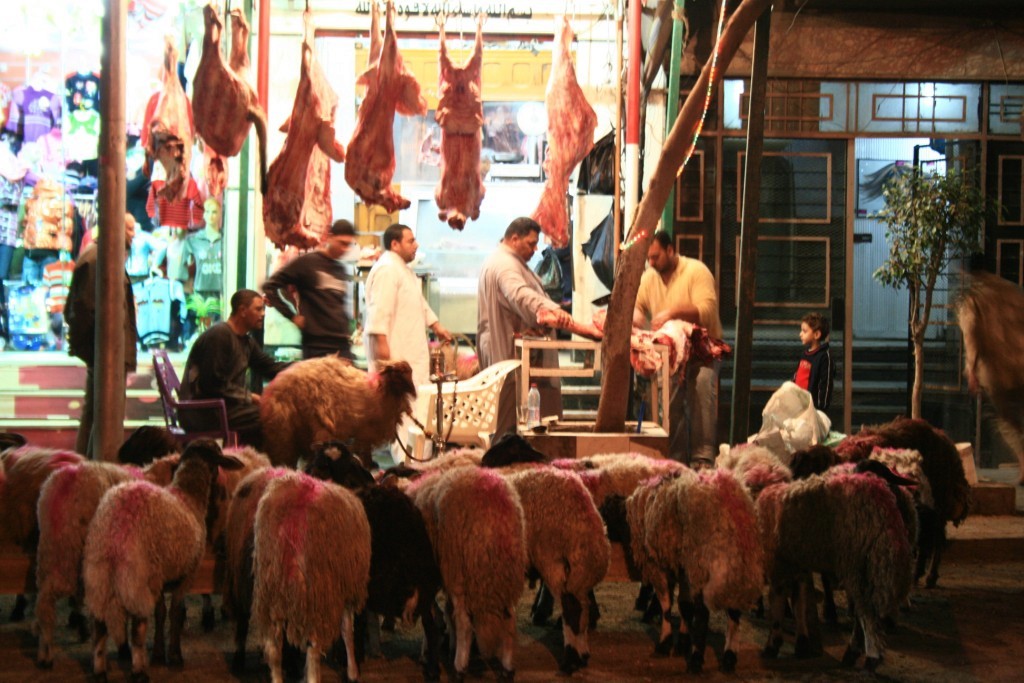
The streets are filled with sheep and the occasional cow in the last days before Eid, the Feast of the Sacrifice. The sheep have been set into makeshift pens and are guarded day and night by a shepherd. They are going for LE1500, or about A$300 each. That means there’s a whole lotta cash messing up the roads here in Cairo

However, it seems that not theft, but small children are the issue most concerning the shepherds. Kids are hanging delightedly around the sheep, trying to wrestle their long horns and ride them the minute the shepherds’ backs are turned. The guys have big sticks they wave at the kids, who fall back slippery as eels, then resettle around the pens, totally uncatchable, laughing and jeering.

It makes logistical sense, but it’s also a bit grim that the sheep are living outside the butchers, snacking cheerfully from wooden troughs. Above them hang the carcasses of their peers but being sheep, they don’t seem to have made the connection. Or perhaps they’re in denial.

Today, Egyptians fasted on the last day before Eid, then the sacrificing begins after prayers at sunrise tomorrow morning.

I took pix down the street last night, got mobbed by about 20 kids, and the old market women who kill the rabbits and pigeons for a living were shouting in the street, “Our cow’s getting photographed by Australia!” I also snapped two happy bakers with one of the huge mountains of bread on the street that tomorrow will become part of fattah, the traditional Egyptian dish of rice, fried bread and meat that I’ve eaten slathered with garlicky mayonnaise.

For the four-day holiday, I’m skipping out to the desert oasis of Siwa with a bunch of friends-to-be, 50km shy of the Libyan border, on the edge of the Great Sand Sea. Land of sand dunes, palm gardens, hot water springs and those weirdly giant plastic date palms that are actually mobile phone towers. Kul sanaa wento tayebeen (Best wishes to all)!

Animal kingdom visits Cairo

Cairo is gearing up for Eid. Last night, as I closed my windows, I heard the familiar sounds of geese disturbed in their sleep, the rooster trying out his pre-dawn lungs and a new sound, the baa-ing of sheep. This is in central Cairo.

Farmers are bringing in their livestock to sell for slaughter during Eid al-Adha, the feast of the sacrifice. The other day, in Gamaliya (Islamic Cairo), a man was whistling a herd of sheep through the main thoroughfare of el-Muiezz. Then I rounded a corner and nearly took out a large cow, one of those mournful Egyptian cows with skinny legs, huge ears and the saddest face that would break your heart.

Walking back from the fruit & veg market, my street has suddenly sprouted several sheep pens with brown shaggy, horned animals milling about, and the sidelanes are like a scene from Animal Farm.

Thursday. It all starts Thursday.

Global Salsa

Well, you’ve scrolled this far. What do you think? Drop me a line, I’d love to hear from you.

Privacy Settings
We use cookies to enhance your experience while using our website. If you are using our Services via a browser you can restrict, block or remove cookies through your web browser settings. We also use content and scripts from third parties that may use tracking technologies. You can selectively provide your consent below to allow such third party embeds. For complete information about the cookies we use, data we collect and how we process them, please check our Privacy Policy
Youtube
Consent to display content from - Youtube
Vimeo
Consent to display content from - Vimeo
Google Maps
Consent to display content from - Google