I’m a journalist, travel writer, editor and copywriter based in Melbourne, Australia. I write pacy travel features, edit edifying websites and fashion flamboyant copy. My articles and photographs have appeared in publications worldwide, from inflight to interior design: I’ve visited every continent, and have lived in three. Want to work together? Drop me a line… 

Follow


Football: the drug of the nation?

It’s been days now. Days since Egypt was defeated by Algeria in its last chance to play in the 2010 World Cup. But Egypt’s not letting go.

Even though Ireland is calling for a rematch from a goal handballed in by a French player who admitted his deed, and the whole European soccer scene is plagued by allegations of widespread match-fixing and subsequent healthy but unusual betting wins, Egypt is still shaking its fist at its North African rivals.

Even I am getting hate Skypes because I’m in Cairo, with someone skyping me and my mother bad names. After giving me a serve in Arabic because I rejected the call, he beat me to the ‘block’ button, spraying venom by text then declaring “iam algerien”. How rude! How badly spelt!

The football channels are full of news of Algerian youths rioting in Marseilles, of stories (quickly disproven) of 11 Algerian deaths in Egypt, of reports of Egypt fans threatened in Sudan, where the game was held. Footage of Algerian fans waving knives (so much for the 15,000 Sudanese riot police) as they chanted in the stadium are flooding the net, and on Friday, what started as a peaceful protest outside the Algerian embassy in leafy (well, as leafy as you’ll get in Egypt) Zamalek ended in yet another riot.

“They are not our Arab brothers,” say my football friends. “We have ended diplomatic ties with them.”

It might come as a surprise to some of you that there are some people in Egypt who are not into football. “At least we’ll talk about something else,” one said to me. Yeah, like bread prices. As my lovely Arabic teacher pointed out, Egypt is full of families who can’t afford their daily bread, which has doubled in the past year to what equate as 12 cents for a plain round of aish balady (brown bread – the processed white is, of course, more expensive again). Instead, they’re reliant on the government bread, at half the price and, apparently, half as palatable.

It’s true football is a drug. I would have said before yesterday, that it is a drug that’s cheaper and healthier than, say, Egypt’s rough and nasty budget drug of choice, bango, which is famously trafficked from the Sinai. But if the alternative is the severance of diplomatic ties with a North African neighbour and fellow Arab country, makes you start thinking otherwise, doesn’t it?

(ps: apologies to The Disposable Heroes Of Hiphoprisy for bastardising the title)
Tension in the hours before Algeria-Egypt match

Palpable. That’s the word of the day. The final qualifier between Algeria and Egypt is being played at 7.30pm local time today, in Sudan. Because it’s not in the Cairo stadium, like Wednesday’s match, when Egypt managed to stave off defeat to go to a rematch, there’s less traffic clogging the streets as we saw when fans poured into the stadium early. Instead, last night, in the dead of night, we spotted buses packed with fans heading down to Sudan.

Word is the Sudanese have waived the usual visa restrictions for Egyptian fans. I heard that tickets cost LE500 (about A$100) but the black market snapped them up and spat them out again for LE2500 (A$500).

TV shows happy Sudanese people rooting for Egypt…but then again, that WAS Egyptian TV. The news wires report that Sudan is “overwhelmingly supportive” of Algeria.

The sport shows have been full of claims and counterclaims of violence: the Algerian team was allegedly attacked in their bus in the airport on arrival into Cairo on Wednesday, and three players appeared on the pitch sporting head bandages. But the driver of the bus said it was all nonsense, that there were a few people managing to sling some mud at the bus, but the team themselves smashed the windows to paint Egypt in a bad light.

Also for a few brief minutes were reports in the Algerian online press of 11 people killed at Cairo stadium at the Wednesday match. The stories were quickly whipped down, but not before they’d travelled the world. Egypt is full of righteous indignation. They know they could lose the chance to attend the 2010 World Cup if FIFA decides they can’t control their fanatical fans.

So it’s four hours to kick-off and the drums are ready…

Monkey business and Pet Shop Boys

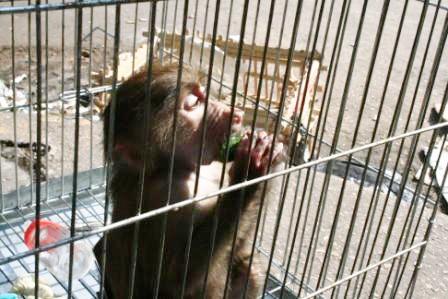
Cliched title, I know. Due to popular demand, I went back down to the pet shop that had a monkey/ape (I’m not so good at primate identification) and snapped a pic for you. And there were two!

The one I saw the other day is the larger, hairier one. For your edification, people, he is nine months old, probably from Sudan or Senegal, costs LE1500 (about A$300 – but that’s the first, pre-haggle price) and his name is Hany.

As I was taking pix of Hany, a little girl let go of her mother’s hand to tear past me, exclaiming, “Mama, beautiful! Beautiful!” She had rushed toward some rather mediocre white kittens, dismissing the exotic Hany with a single glance.

The littler monkey is still being bottle fed. He is just eight months old, with a nose that he wrinkled while devouring pieces of cucumber and displaying his manhood for the crowd and the pet shop boys.

Weird spotting on Cairo streets

Weird things spotted in a neighbourhood walk today: Entire buses full of red, white and black painted men geared up for the Egypt v Algeria match tonight. Cappuccino-mint flavoured toothpaste. A large caged ape for sale on the footpath. Ah, lovely Cairo.

Egypt-Algeria match fever

Tickets went on sale today for the Egypt v Algeria match on Saturday. Boys have already started selling flags on the streets in the lead-up to the match, and it’s rivaling swine flu as the top story of the day.

This is Egypt’s last chance to get into the 2010 World Cup, and the build-up is intense. Algeria needs to win, draw or even lose by just one goal to qualify, but Egypt needs a three-goal margin to qualify. If they come out two goals ahead, they’ll go into another play-off in Sudan on 18 November.

The match will be held at Cairo Stadium, which holds 80,000 fans, and organisers are upping the security to stop them from bringing in fireworks and…lighters. Um, hello, in a country where smoking is a profession? When we watched the Egypt v Zambia match at the stadium, they even took the poles out of our flags.

Fans on both sides have been slagging each other off online for weeks in what’s been described as a cyber-war that’s downright nasty. They’ve hacked the websites of the major newspapers and even the prez, Hosni Mubarak, isn’t immune, with his own website getting done over.

An Algerian song on YouTube is poking at Egypt’s defeat in the 1967 Six Day war with Israel (“We are not the ones who sold Palestine to the Jews”) while Egypt slapped back with the gibe, “”We liberated you when France made you slaves/Talk to me in French because your Arabic is so broken.” As you can see, they’re playing nice.

I love the fact the National Heart Institute has issued a warning to heart patients, telling them not to watch the match. Quoting a Swiss study that found a 60 percent rise in heart attacks in the last World Cup, the good doctor has advised Egyptians to exercise, avoid smoking and drinking alcohol and refrain from fast food before watching the match.

Women and girls are being told to stay home (they can’t shout loud enough, anyway), though with a history of rioting at previous games between the two countries, many girls will be happy to steer clear.

If Egypt wins, Cairo will burn and the car horns won’t stop till dawn. If she loses, this will be one sorry city.

Getting piggy

I got a call from a friend today: he was livid. His kids’ expensive school here in Cairo has been closed because of an outbreak of swine flu – a common story, even my bro is enjoying a little paid holiday due to the same at his school in Ukraine.

However, when my Egyptian friend took his kids to hospital to have them checked out, he found people crammed in the hospital, flu or not, all breathing the same ikky, sickky hospital air while they waited their turn.

Yesterday, the Egyptian health minister announced hospitals would no longer test people with suspected swine flu – doctors have been told just to whack the suspects full of Tamiflu and the usual anti-viral medication because it’s cheaper than throat swabs and lab work.

Egypt has reported its sixth death due to swine flu (compared with 4000 or so in the US), so it’s no wonder I get the hairy eye when I get on the metro, as we foreigners are considered the culprits. Like the kids in the photo above, some women are wearing those white face masks beloved of Asian countries (I heard eyewitness reports of a group of Japanese tourists climbing through the pure air of Mt Moses in Sinai wearing white masks), while muniquabbas, women who wear the face veil and gloves, must surely feel insulated and protected.

Egypt loves a good conspiracy theory: is it an American plot? A disease created by cash-hungry multi-national drug companies owned by Donald Rumsfeld, the US Secretary of Defense? The work of an anti-pig lobby group? It’s been labeled a pandemic, and there are rumours that 20,000 Egyptians are being infected every day, but the Ministry of Health says there are precisely 1881 cases of swine flu in Egypt. Aaah, nobody takes the government figures seriously. The one good thing about swine flu is the government’s personal hygiene campaign – perhaps Egyptians will stop throwing their used tissues out car windows and on the ground.

(Photo credit: AFP)

Copping it not so sweet

Yesterday there was a loud bang outside my window. I went outside to check to find police blocking off street. Mild panic, as I live beside one of the city’s palaces, where Obama dossed for an hour or two when he was in Egypt earlier this year.

The traffic started to pile up as the two policemen in their summer white uniforms (they should be changing to winter black soon) waved the traffic into a side road.

Then I realised that the police were trying to jump-start their car and the banging was actually the police car backfiring while it blocked the road. How can they chase the baddies when they’re in the worst cars on the road?

The traffic cops are hilarious. They’ll be holding up half of Cairo’s traffic, minibuses with boys hanging on the outside walls, little taxis on the school run crammed with a dozen wriggling children, dudes revving their hot engines, women drivers with big dark sunglasses and their hands permanently on the horn, everyone champing at the bit.

But the cops are having a fag and a cuppa tea, perving on some pretty girls or having a natter on their mobile, completely oblivious to the mountain of heated angst and black exhaust fumes pouring from the cars behind their hands. Then finally the din of a hundred car horns gets their attention when someone finally starts shrieking, and they’ll step back to unleash hell.

The official stats say 6000 people are killed in road accidents every year in this country which until less than 10 years ago put a luxury tax on seatbelts.

But a friend disputes this. Whipping out his calculator, he tells me that’s 16 people a day. “No way. No way,” he says, reckoning it’s at LEAST double that. We’re bouncing over the most potholed road on the Sinai as we continue the conversation, the car’s underbelly thumping on a bed of rock. “Look at this,” he says, pointing at the crumbling road. “There are more than 80 million of us Egyptians. Maybe the government thinks there should be less…”

Love, acid and lost shoes: notes from Cairo’s dailies…oes:

A snippet from a regular column in The Egyptian Gazette by journalist Hugh Nicol, titled “Red-Handed”, which salubriously details local crimes, very often featuring rather horrific crimes of passion. See below.

“A 23-year old woman called Samar Attiya got her revenge on the lover who refused to marry her by pouring acid on a sensitive part of his body in the early hours of the morning. The young man died of his injuries in hospital.

The deceased 25-year-old Ahmed Moustafa, an accountant from Maadi, was due to get engaged [to another woman] the following day…Two of Ahmed’s friends told police that he’d been intimate with a young woman called Samar, whom he refused to marry. She then asked him to pay for a hymen reconstruction operation, in order to prevent scandal. When he didn’t cooperate, she got in touch with the woman who he was planning to marry and started threatening her. Samar, a 23-year-old nurse from Shubra el-Kheima…admitted killing Ahmed, explaining that she slept with him because he’d promised to marry her.

On the night he died, Samar rang Ahmed and told him she wanted to make love with him just one more time before he got engaged to the other woman. He met her in the early hours of the morning on the Cairo-Helwan Agricultural Road.

She got into his car and they started making out together. Samar got him to lie on the back seat. She then pulled off his trousers and poured the lethal acid…on his chopper.”

Chopper. Hmmm. Other notable stories this week include a teacher from Alexandria charged with beating a tardy student with a stick, breaking two ribs. Notable because last year, another Alex teacher was convicted of beating a student to death.

And the lead story: The Egyptian transport minister has resigned over the rail crash that killed 18 people earlier this week. The crash took place when one train stopped as there was a water buffalo on the track, and a second train rear-ended the first. Three railway workers, who were supposed to be watching the track, have been charged with manslaughter. One survivor reminisced about an injured woman “screaming for her new shoe and asking other wounded passengers to help her find it”.

The daily cartoon is particularly bleak: a man buying a train ticket from the station window is asked for his destination, to which he replies, “The hereafter”. Thanks to everyone who thoughtfully emailed to make sure I wasn’t on the train.

At the feet of gods: Cruising Lake Nasser to Abu Simbel

Hi all, Egypt’s going great guns in the Australian press at the moment. This piece appeared this week in Sydney’s Sun Herald newspaper. Much is drawn from blogs, so don’t yell if you think you’ve read some of it before!

At the feet of gods: Cruising Lake Nasser to Abu Simbel

If you were asked how you’d like to spend a year of your 20s when you’re fit, strong and virile, you probably wouldn’t choose a drowned Nubian desert with no women, no shops, late-night cafes and definitely no all-night rave clubs. Unfortunately for the young Egyptian guy standing in front of me, that’s exactly the hand he’s been dealt.

He’s stuck here in southern Egypt, serving his compulsory military service in a grubby might-have-been-white uniform as part of the police presence at the historical temple complex of Wadi el-Seboua.

We get excited spotting him as he’s one of the few people we see from our cruiser, the MS Kasr Ibrim, as we coast from Aswan to Abu Simbel on the silent waters of Lake Nasser, just north of the Sudanese border.

“No photos, no photos!” he shouts as we attempt to snap the first living thing we’ve seen all day.

But every time he senses a camera, he avoids eye contact and assumes a suspiciously practised pose, gazing out to the water, gun at the ready.

These temple sites are serious one-donkey affairs and accessible only by boat. “In 2009, the lake is considered isolated but in 1300BC, when the Pharaoh Ramses II built these temples, this would have been considered the end of the Earth,” our guide, Safi, says, waggling a long finger. For the policeman, it still is. Aside from travellers in a few luxury cruisers, the only people the young copper sees are the temple guards from the Egyptian Department of Antiquities and some fishermen who double as camel-tour touts.

There’s just the temple and the lake. For him it’s hell but for us spoilt few, it’s two flights downstairs from heaven.

Lake Nasser is the world’s largest artificial lake and is often described as one of the great engineering feats, a statement that, unless you’re an engineer, just makes you want to nod off.

It’s not until you’re on the lake – and concurrently in the midst of the desert – that it sinks in. Lake Nasser is more than 500 kilometres long and up to 30 kilometres wide. Unlike the Lower Nile cruises between Aswan and Luxor, you can barely see the coastline. And what you can see is desert, sans oases. No lush palms, little villages or happy farming scenes.

Occasionally, we spot a tiny shack for fishermen chasing balti and the monstrous Nile perch that can grow to more than 180 centimetres long and tip the scales past 170 kilograms.

Of the handful of cruisers operating on Lake Nasser, our boat, a 1920s art deco extravaganza named after a ruined Nubian fortress, is the best known. Instead of a single cabin with a porthole the size of a pigeon’s eye, I’ve landed a suite with a wraparound sundeck and walls of walnut veneer. There are a few old-fashioned touches, like the built-in radio near the bedhead and the paper hygiene strip wrapped around the toilet a la the Miss Congeniality sash on a beauty queen.

The Kasr Ibrim is usually 60:40 French to Brits, though this time the French have well and truly won and there are but nine native English speakers on board. We’re a small, energetic group, me and the Brits in their 50s and 60s, and are raring to go with Safi, our own hip, lanky guide.

While still moored in Aswan, we take a little boat out to the Temple of Kalabsha, set on a sometimes-island in the lake. We take in the nitty-gritty of the carvings – sure there’s Horus, Isis and all the ancient godly gang but also reliefs of macho Ramses II giving some Nubian soldiers a good hiding, receiving an exotic procession of people bearing leopard skins, shields, fox furs, monkeys, cheetahs and giraffes and, as a full-grown man, being breastfed by goddesses; cue for naughty snickering and talk of Oedipal complexes.

The next morning we set sail, navigating the original channel of the River Nile. Looking over the pilot’s shoulder, I see dark spots on the radar, a drowned landscape submerged in up to 180 metres of water.

We clink glasses as we cross the Tropic of Cancer and stop to explore the temples of Dakka, Amada, Derr and the ancient tomb of Penout, where a bloke wearing a dusty jellabiya waggles a baby crocodile at me. “Five pounds for a photo,” he mutters as I pass.

It might be just a few weeks old but already the Nile crocodile has the 1000-yard stare of a born killer. They’re famously bad-tempered and famously shy of humans (despite having a taste for us) and we spot a grown-up croc languishing on a muddy riverbank giving a few flamingos the eye before sliding into the waters. In their heyday, the temples along the lake’s shores were part of the lands of Nubia, one of those ephemeral concepts of a country where a distinct ethnic group’s traditional lands have been swallowed by surrounding countries or, in this case, a lake.

Poor Nubians – they’ve been beaten by both ends of the stick. Their heritage was first lost to the shifting desert sands, then rediscovered in the early 1800s when a Swiss explorer stumbled upon Abu Simbel, only to be lost once again, along with their villages, to the rising waters of the dammed Nile in the 1970s. It gives a whole new meaning to being between a rock and a hard place.

The government relocated the 800,000-odd villagers, paying them a small compensation, and when the global village realised the proposed Aswan High Dam, built between 1958 and 1971, would also immerse a swag of significant temples, 54 countries rushed in to perform heroic piece-by-piece removals and reconstructions, including the piece de resistance, the relocation of Abu Simbel.

After three days’ easy sailing, we arrive at Abu Simbel, the jewel of Nubia, bang on lunchtime. Our cruiser prowls the waters in front of the temples for a rare view of the 13th-century BC temple, with the megalomaniacal tribute to Ramses II – four 20-metre colossi demanding the attention of our cameras. Forget schlepping through the temple in the heat of the day with the hundreds of tourists who’ve flown down or travelled from Aswan in a convoy of buses, though; later, once the weather cools and the other tourists have gone home, we’ll disembark to explore the temples in relative peace. But for now, we will take lunch with kings and gods.

During the relocation, the temple was sliced into 830 blocks and moved up and away from the lake. Only the faces remained uncut.

The temple was even reconstructed so the sun still falls on Ramses’s face twice a year, on his birthday and his ascension to the throne, as per the original design.

Essentially, Abu Simbel was an enormous public-relations exercise – those entering the kingdom from the south via the Nile would be reminded of the greatness of that land’s ruler by being confronted by massive statues of Ramses. Word has it he was a bit of a cuckoo, stealing earlier kings’ victories by slapping his cartouche everywhere, talking himself up as ruler of the world. Seems he was more a lover than a fighter, fathering almost 100 children.

Beside the great temple of Ramses II is the smaller temple of the mother-goddess Hathor, built for Ramses’s beloved and beautiful wife, Nefertiti. Inside her temple are massive reliefs of the battle of Qadesh in 1275BC, where Ramses shows off, sticking it to the Hittites in a classic case of: “Look at me, Nefertiti!”

Officially, you can’t take photos inside the temple but for an idea of scale, thousands of tourists are snapped beside Ramses’s seated statues at the front of the temple. Little ants, we barely reach the top of his great toes.

We stay at the temples until dusk, then take a seat at his feet for the sound and light show.

“Son of the sun, king of eternal time,” begins the stentorian voice of the storyteller in the darkness.

Clouds of light race across the night sky to grow stronger until they illuminate the temples of Abu Simbel. Lover, fighter, builder, glory hound: Ramses II is showing nightly, proof that fame is the elixir of eternal youth.

GETTING THERE

Etihad Airways flies from Sydney and Melbourne to Cairo via Abu Dhabi. Phone 1800 998 995, see etihadairways.com. EgyptAir flies Cairo-Aswan-Abu Simbel.

SIGHTSEEING

MS Kasr Ibrim sails every Saturday from Aswan to Abu Simbel for four nights-five days and every Wednesday from Abu Simbel for three nights-four days. Winter berths (October-April) are priced from €173 ($278) a person, a night, twin share. Includes all meals, a guide and entrance to all sights. Book through Soleils d’Egypte, phone +202 2644 0150, email contact@soleilsdegypte.com, or Nemonic Concepts, phone (02) 9526 8519, see nemonic.com.au. Also see kasribrim.com.eg

The Abu Simbel Sound and Light Show takes about 35 minutes, see soundandlight.com.eg

FURTHER INFORMATION

See egypt.travel

Smokin’ in Cairo

Just to prove I’m not moaning on Facebook about nothing, here’s the lead story for this week’s English version of Al-Ahram newspaper.

‘For once, as it turns out, the burning of rice chaff by Nile Delta farmers is not responsible for the seasonal air pollution known as the black-cloud phenomenon, writes Mahmoud Bakr. Or so the Ministry of State for Environmental Affairs assures us.

Air pollution this week is the result of a dust storm that started in Chad and blew over North Africa, according to Ahmed Abul-Soud, head of the Air Quality Department at the ministry, taking a northeasterly direction and covering a large expanse of southern and northern Egypt on Saturday evening and the next day. For their part farmers have not however stopped burning their chaff, despite more severe fines and other efforts on the part of the ministry. Maged George, the minister of state for environmental affairs, warned of air pollution in the next few weeks due precisely to the burning of rice chaff, elaborating on the ministry’s plan to encourage recycling on a large scale.

photo: Mohamed Mustafa

Global Salsa

Well, you’ve scrolled this far. What do you think? Drop me a line, I’d love to hear from you.

Privacy Settings
We use cookies to enhance your experience while using our website. If you are using our Services via a browser you can restrict, block or remove cookies through your web browser settings. We also use content and scripts from third parties that may use tracking technologies. You can selectively provide your consent below to allow such third party embeds. For complete information about the cookies we use, data we collect and how we process them, please check our Privacy Policy
Youtube
Consent to display content from - Youtube
Vimeo
Consent to display content from - Vimeo
Google Maps
Consent to display content from - Google