I’m a journalist, travel writer, editor and copywriter based in Melbourne, Australia. I write pacy travel features, edit edifying websites and fashion flamboyant copy. My articles and photographs have appeared in publications worldwide, from inflight to interior design: I’ve visited every continent, and have lived in three. Want to work together? Drop me a line… 

Follow


Sandboards, springs and the Schumacher of Siwa

It’s an obvious fact that once Cairenes are more than 15km past the outskirts of their town, they must tie a scarf on their heads.

Preferably a black-and-white checkered one, and then a pair of mirrored aviator sunglasses, which seem to look good only on Arabs. Inevitably, we Caucasians end up looking like bad Tom Cruise wannabes or misguided PLO supporters.

So here’s the picture: 20 Cairenes attempting to sandboard the dunes of the Great Sand Sea, in far western Egypt. Thinking it would be a repeat of the last time I sandboarded – a terrifying face-first rocket down a dune I couldn’t see the bottom of – I opted out. For decorum’s sake, I gave it a hurl one last time, going down seated, but did a fairly spectacular face-plant and filled my ears with sand.

Soon everyone else who went up and down was mummified in a shell of sand glued together with sweat. Despite it being winter, this is still the Libyan Desert, friends, and that means warm days and cold nights in winter. Eyebrows disappeared beneath a layer of caramel sand, and the ever-prepared girls were giving the packets of hand wipes a good working out.

The sand came off in Bir Wahid, a hot water spring in the midst of the sand dunes. All the drivers converge there before sunset to hang out and chat, meaning the spring itself was full of bathers from all over the world, including a convoy of elderly Japanese. While I bobbed in the clean water, I chatted with a French woman, who, it turns out, was the sister-in-law of a lady I met at lunch in Mombasa, Kenya, a few months ago. The world is small and we are all but bit players.

Later that night, our Schumacher of Siwa, Nasr (that’s him here), would drive us out to a Siwi ‘party’ to hang out around the fire and watch the local boys doing their distinctive dance.

Nasr was, by this time, becoming addicted to the sound of our screams, and turned off his headlights to drop the 4WD down the dunes in the darkness.

Scream? We screamed in unison, in harmony and in mild terror. It was music to Nasr’s ears.

Visiting the Oracle

“Who goes to Siwa for three days?” a local asked me.

Well, me. And my 20 new friends. I could see the Siwan local’s point, though. Siwa is an oasis in Egypt’s Western Desert, just 50km from the Libyan border. To call the road journey there a slog is an understatement: it took us 12 hours with stops to cram chips and juice, tea and dodgy croissants at all-night road stops along the route that heads up toward Alexandria till you turn a sharp left and keep on driving another nine or 10 hours.

We left Cairo on the Thursday night before Eid Al-Adha, the Feast of the Sacrifice, which I wrote about two blogs ago. The holiest of prayers is on the Friday morning, so at first light, we pulled up in front of a crumbling, empty mosque in the middle of nowhere. The adaan had turned the reverb up on the loudspeaker, and while some prayed, the rest of us slept in the bus or, like me, wandered in the cold desert night to stretch our legs and listen to the chill wind.

The second stop for prayers was an hour later, in another roadside mosque near Marsa Matrouh, this time a makeshift affair with screens up for the women to pray in, while the men lined up behind the old building. As we pulled up, we saw dozens of Bedouin families rolling up in trucks or walking across the highway from a cluster of shacks to pray, with an improbable amount of young boys in white gellibayas with black waistcoats over the top, shooting each other with their Eid toys, mostly semi-automatic rifles and machine guns.

By the time we got to our hotel, Siwa Gardens, a hessian sack on a concrete floor would have sufficed. But the spring-fed pool and pretty domed ceilings (natural air-conditioners, they’re cool in summer) made up for it all.

After a swim and shower, we headed out on the town. The oasis comprises the main town, built around the crumbling mudbrick Shali fortress, and a scattering of villages amongst the palm gardens and out along desert tracks. Donkey carts are the main form of transport, though they’re under threat from cheap Chinese motorbikes. The main industries are bottling spring water and growing dates and olives. My guidebook suggests that the town’s Bank of Cairo might be the world’s only bank made from mudbrick. It’s ATM coughed up cash and the clerk spoke good English. What more do you need?

I miss my bike in Australia even more after we hired some sturdy but wonky beasts to explore with. The afternoon passed in a deliciously blurry breeze – skimming on rough tracks through the palm gardens, past hot and cold natural springs and chasing donkey carts loaded with shrouded women and children in bright silks, visiting relatives on the first day of the feast.

At the temple of the Oracle of Amon, we listened for the clues to what Alexander the Great might have whispered to the Oracle before taking Egypt for his own. The Oracle wasn’t telling; she is sleeping in her hilltop fortress as life moves slowly amongst the palms below.

Watching the movies, watching the moviegoers

My ears are still doing that weird void of silence things after an assault in the cinema at Cairo’s glamour mall, City Stars. I know Egypt has only two levels of volume: off and 10 and like the rest of the region, love nothing more than a good blast of polar-strength air-con. Loud and cold is probably not the best environment to enjoy a movie, though, especially the three-hour doomsday saga of 2010.

As interesting as the movie were the clientele: being the holiday period of Eid, Cairo is once again full of holidaying Arab guys (that’s Saudi Arabians, for you and me) with their long hair and fat wallets. Also, one of our gang was shocked to see a munaqqabah in the cinema. The niqab is the all-encompassing dress some women wear that leave only their eyes visible, and lately I’ve been noticing women on the metro who go the final step and have a piece of black gauze over their eyes so they can see out but you can’t see in.

What’s so weird about a woman wearing the niqab in the cinema? I asked, only to be reminded that many in this super-conservative group consider movies and music to be haram, or against Islam.

Recently, the imam of Al-Azhar mosque, the esteemed seat of Islamic learning, banned the niqab from female-only classrooms in the mosque’s schools, secondary schools and university institutions. The debate amongst bloggers is raging.

I don’t know a lot about it: I do know women wearing the niqab aren’t so keen to sit beside the obviously non-Muslim foriegner, though I had a chat with a nice young munaqqabah last week on the train. Locals can’t understand my fascination with the topic, but I maintain that what people don’t understand, they fear. And in a time when the world is in religious upheaval, understanding and appreciation are the only ways toward acceptance and tolerance.

(Pic credit: Bikyamisr)

The night before Eid

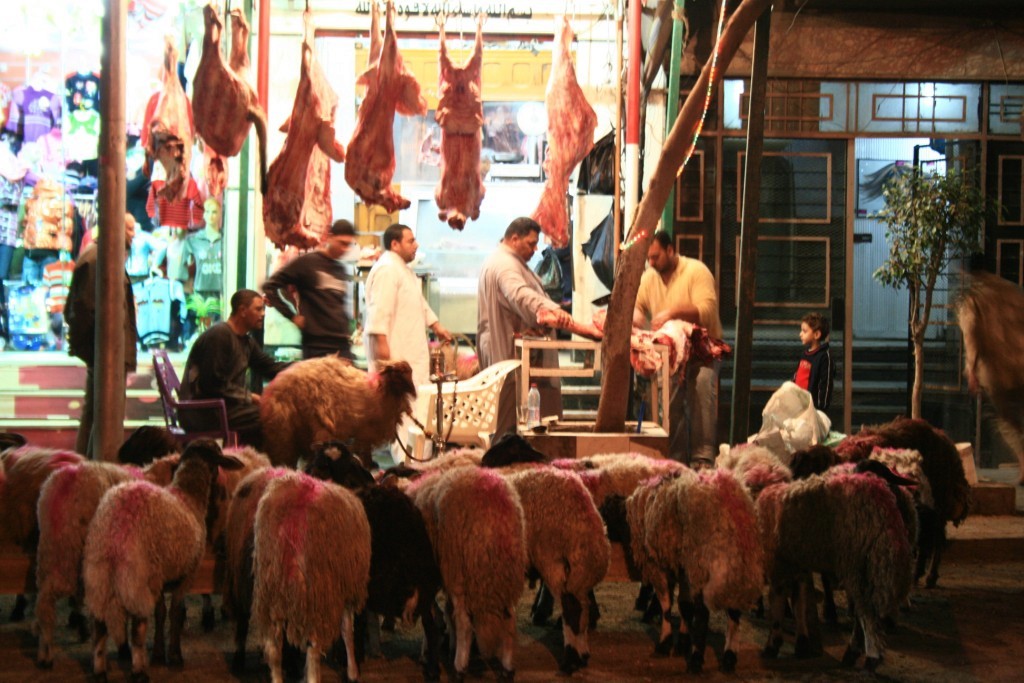
The streets are filled with sheep and the occasional cow in the last days before Eid, the Feast of the Sacrifice. The sheep have been set into makeshift pens and are guarded day and night by a shepherd. They are going for LE1500, or about A$300 each. That means there’s a whole lotta cash messing up the roads here in Cairo

However, it seems that not theft, but small children are the issue most concerning the shepherds. Kids are hanging delightedly around the sheep, trying to wrestle their long horns and ride them the minute the shepherds’ backs are turned. The guys have big sticks they wave at the kids, who fall back slippery as eels, then resettle around the pens, totally uncatchable, laughing and jeering.

It makes logistical sense, but it’s also a bit grim that the sheep are living outside the butchers, snacking cheerfully from wooden troughs. Above them hang the carcasses of their peers but being sheep, they don’t seem to have made the connection. Or perhaps they’re in denial.

Today, Egyptians fasted on the last day before Eid, then the sacrificing begins after prayers at sunrise tomorrow morning.

I took pix down the street last night, got mobbed by about 20 kids, and the old market women who kill the rabbits and pigeons for a living were shouting in the street, “Our cow’s getting photographed by Australia!” I also snapped two happy bakers with one of the huge mountains of bread on the street that tomorrow will become part of fattah, the traditional Egyptian dish of rice, fried bread and meat that I’ve eaten slathered with garlicky mayonnaise.

For the four-day holiday, I’m skipping out to the desert oasis of Siwa with a bunch of friends-to-be, 50km shy of the Libyan border, on the edge of the Great Sand Sea. Land of sand dunes, palm gardens, hot water springs and those weirdly giant plastic date palms that are actually mobile phone towers. Kul sanaa wento tayebeen (Best wishes to all)!

Animal kingdom visits Cairo

Cairo is gearing up for Eid. Last night, as I closed my windows, I heard the familiar sounds of geese disturbed in their sleep, the rooster trying out his pre-dawn lungs and a new sound, the baa-ing of sheep. This is in central Cairo.

Farmers are bringing in their livestock to sell for slaughter during Eid al-Adha, the feast of the sacrifice. The other day, in Gamaliya (Islamic Cairo), a man was whistling a herd of sheep through the main thoroughfare of el-Muiezz. Then I rounded a corner and nearly took out a large cow, one of those mournful Egyptian cows with skinny legs, huge ears and the saddest face that would break your heart.

Walking back from the fruit & veg market, my street has suddenly sprouted several sheep pens with brown shaggy, horned animals milling about, and the sidelanes are like a scene from Animal Farm.

Thursday. It all starts Thursday.

Football: the drug of the nation?

It’s been days now. Days since Egypt was defeated by Algeria in its last chance to play in the 2010 World Cup. But Egypt’s not letting go.

Even though Ireland is calling for a rematch from a goal handballed in by a French player who admitted his deed, and the whole European soccer scene is plagued by allegations of widespread match-fixing and subsequent healthy but unusual betting wins, Egypt is still shaking its fist at its North African rivals.

Even I am getting hate Skypes because I’m in Cairo, with someone skyping me and my mother bad names. After giving me a serve in Arabic because I rejected the call, he beat me to the ‘block’ button, spraying venom by text then declaring “iam algerien”. How rude! How badly spelt!

The football channels are full of news of Algerian youths rioting in Marseilles, of stories (quickly disproven) of 11 Algerian deaths in Egypt, of reports of Egypt fans threatened in Sudan, where the game was held. Footage of Algerian fans waving knives (so much for the 15,000 Sudanese riot police) as they chanted in the stadium are flooding the net, and on Friday, what started as a peaceful protest outside the Algerian embassy in leafy (well, as leafy as you’ll get in Egypt) Zamalek ended in yet another riot.

“They are not our Arab brothers,” say my football friends. “We have ended diplomatic ties with them.”

It might come as a surprise to some of you that there are some people in Egypt who are not into football. “At least we’ll talk about something else,” one said to me. Yeah, like bread prices. As my lovely Arabic teacher pointed out, Egypt is full of families who can’t afford their daily bread, which has doubled in the past year to what equate as 12 cents for a plain round of aish balady (brown bread – the processed white is, of course, more expensive again). Instead, they’re reliant on the government bread, at half the price and, apparently, half as palatable.

It’s true football is a drug. I would have said before yesterday, that it is a drug that’s cheaper and healthier than, say, Egypt’s rough and nasty budget drug of choice, bango, which is famously trafficked from the Sinai. But if the alternative is the severance of diplomatic ties with a North African neighbour and fellow Arab country, makes you start thinking otherwise, doesn’t it?

(ps: apologies to The Disposable Heroes Of Hiphoprisy for bastardising the title)

Tension in the hours before Algeria-Egypt match

Palpable. That’s the word of the day. The final qualifier between Algeria and Egypt is being played at 7.30pm local time today, in Sudan. Because it’s not in the Cairo stadium, like Wednesday’s match, when Egypt managed to stave off defeat to go to a rematch, there’s less traffic clogging the streets as we saw when fans poured into the stadium early. Instead, last night, in the dead of night, we spotted buses packed with fans heading down to Sudan.

Word is the Sudanese have waived the usual visa restrictions for Egyptian fans. I heard that tickets cost LE500 (about A$100) but the black market snapped them up and spat them out again for LE2500 (A$500).

TV shows happy Sudanese people rooting for Egypt…but then again, that WAS Egyptian TV. The news wires report that Sudan is “overwhelmingly supportive” of Algeria.

The sport shows have been full of claims and counterclaims of violence: the Algerian team was allegedly attacked in their bus in the airport on arrival into Cairo on Wednesday, and three players appeared on the pitch sporting head bandages. But the driver of the bus said it was all nonsense, that there were a few people managing to sling some mud at the bus, but the team themselves smashed the windows to paint Egypt in a bad light.

Also for a few brief minutes were reports in the Algerian online press of 11 people killed at Cairo stadium at the Wednesday match. The stories were quickly whipped down, but not before they’d travelled the world. Egypt is full of righteous indignation. They know they could lose the chance to attend the 2010 World Cup if FIFA decides they can’t control their fanatical fans.

So it’s four hours to kick-off and the drums are ready…

Monkey business and Pet Shop Boys

Cliched title, I know. Due to popular demand, I went back down to the pet shop that had a monkey/ape (I’m not so good at primate identification) and snapped a pic for you. And there were two!

The one I saw the other day is the larger, hairier one. For your edification, people, he is nine months old, probably from Sudan or Senegal, costs LE1500 (about A$300 – but that’s the first, pre-haggle price) and his name is Hany.

As I was taking pix of Hany, a little girl let go of her mother’s hand to tear past me, exclaiming, “Mama, beautiful! Beautiful!” She had rushed toward some rather mediocre white kittens, dismissing the exotic Hany with a single glance.

The littler monkey is still being bottle fed. He is just eight months old, with a nose that he wrinkled while devouring pieces of cucumber and displaying his manhood for the crowd and the pet shop boys.

Weird spotting on Cairo streets

Weird things spotted in a neighbourhood walk today: Entire buses full of red, white and black painted men geared up for the Egypt v Algeria match tonight. Cappuccino-mint flavoured toothpaste. A large caged ape for sale on the footpath. Ah, lovely Cairo.

Egypt-Algeria match fever

Tickets went on sale today for the Egypt v Algeria match on Saturday. Boys have already started selling flags on the streets in the lead-up to the match, and it’s rivaling swine flu as the top story of the day.

This is Egypt’s last chance to get into the 2010 World Cup, and the build-up is intense. Algeria needs to win, draw or even lose by just one goal to qualify, but Egypt needs a three-goal margin to qualify. If they come out two goals ahead, they’ll go into another play-off in Sudan on 18 November.

The match will be held at Cairo Stadium, which holds 80,000 fans, and organisers are upping the security to stop them from bringing in fireworks and…lighters. Um, hello, in a country where smoking is a profession? When we watched the Egypt v Zambia match at the stadium, they even took the poles out of our flags.

Fans on both sides have been slagging each other off online for weeks in what’s been described as a cyber-war that’s downright nasty. They’ve hacked the websites of the major newspapers and even the prez, Hosni Mubarak, isn’t immune, with his own website getting done over.

An Algerian song on YouTube is poking at Egypt’s defeat in the 1967 Six Day war with Israel (“We are not the ones who sold Palestine to the Jews”) while Egypt slapped back with the gibe, “”We liberated you when France made you slaves/Talk to me in French because your Arabic is so broken.” As you can see, they’re playing nice.

I love the fact the National Heart Institute has issued a warning to heart patients, telling them not to watch the match. Quoting a Swiss study that found a 60 percent rise in heart attacks in the last World Cup, the good doctor has advised Egyptians to exercise, avoid smoking and drinking alcohol and refrain from fast food before watching the match.

Women and girls are being told to stay home (they can’t shout loud enough, anyway), though with a history of rioting at previous games between the two countries, many girls will be happy to steer clear.

If Egypt wins, Cairo will burn and the car horns won’t stop till dawn. If she loses, this will be one sorry city.

Global Salsa

Well, you’ve scrolled this far. What do you think? Drop me a line, I’d love to hear from you.

Privacy Settings
We use cookies to enhance your experience while using our website. If you are using our Services via a browser you can restrict, block or remove cookies through your web browser settings. We also use content and scripts from third parties that may use tracking technologies. You can selectively provide your consent below to allow such third party embeds. For complete information about the cookies we use, data we collect and how we process them, please check our Privacy Policy
Youtube
Consent to display content from - Youtube
Vimeo
Consent to display content from - Vimeo
Google Maps
Consent to display content from - Google