I’m a journalist, travel writer, editor and copywriter based in Melbourne, Australia. I write pacy travel features, edit edifying websites and fashion flamboyant copy. My articles and photographs have appeared in publications worldwide, from inflight to interior design: I’ve visited every continent, and have lived in three. Want to work together? Drop me a line… 

Follow


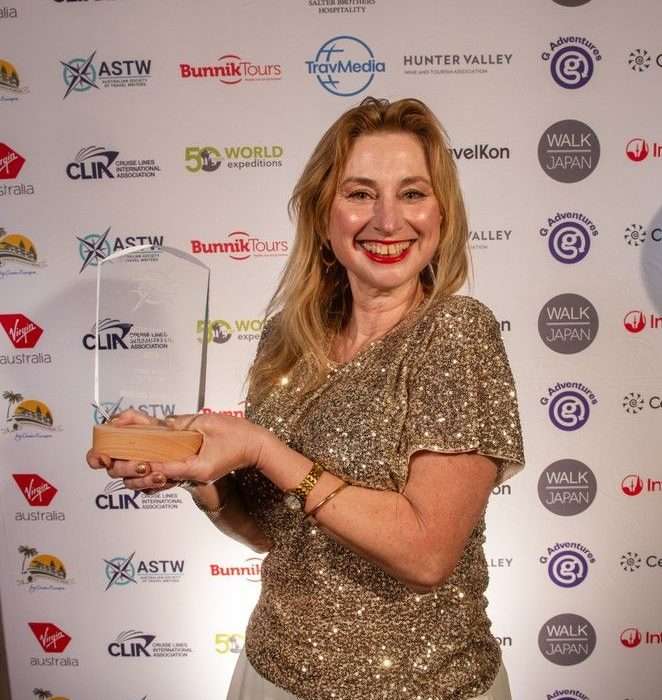
Belinda Jackson wins Travel Writer of the Year 2025-26

I am so pleased to announce that I’m the Australian Society of Travel Writers’ new Travel Writer of the Year!

The awards were announced at a gala celebration hosted by the City of Greater Bendigo, and I couldn’t be more proud. It is the second time I’ve won this prestigious award, the last time was two years ago.

The three stories in my portfolio were drawn from Saudi Arabia, Oman and southern Spain, places I love equally, and were published in the Traveller section of the The Sydney Morning Herald and The Age, and in Luxury Escapes‘ glossy Dream magazine.

Traveller: AlUla, Saudi Arabia with The Royal Commission for AlUla Read the story here
Traveller: Southern Spain train odyssey with InnTravel Read the story here
Luxury Escapes: Heaven Scent in Oman, with Emirates, Anantara Hotels & Resorts and Shangri-La Group

The very generous prize is two business class tickets on Virgin Australia‘s domestic and short-haul international network – I reckon they’ll be easy to use!

Thank you to the Australian Society of Travel Writers, to the editors including Paul Chai, Craig Platt, Anthony Dennis, Jane Reddy and Trudi Jenkins, and to the tourism companies that continue to help travel journalists and writers produce detailed, quality (fact-checked) features, and to the public relations professionals who support and back us, even as budgets tighten and soundbites shorten. Huge thanks to Barking Owl Communications, Julia Spence PR, Lara McCabe at Burson, Nick Flynn, Zoe Shurgold and of course the sponsors, Virgin Australia

And a shout out to the team at Niyama Private Islands Maldives where I’m currently working on my next story (yep, it’s as tough as it sounds), who baked me the most beautiful cake when they heard the news.
Shortlisted for Australian Travel Writer of the Year 2025

I’m very, very pleased to announce that I’ve been shortlisted again for Travel Writer of the Year in the Australian Society of Travel Writers 2025 awards!

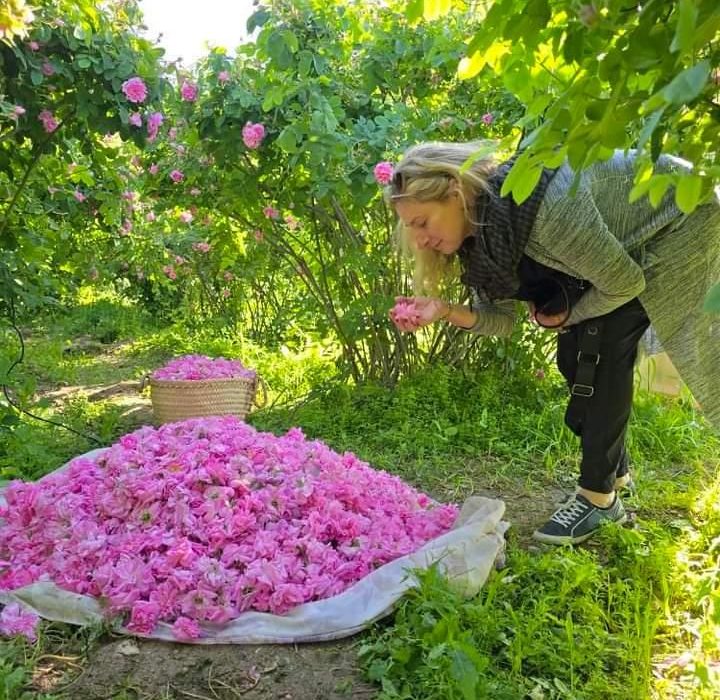
I titled my collection of three features The Underrated and the Understated, reporting on a train journey in southern Spain, AlUla in Saudi Arabia and Oman (that’s me, stopping to smell the roses, after being trapped in flooded Dubai on the way to that mountain of fragrance).

Thanks to ASTW and to the companies who continue to support travel journalism, including InnTravel, Saudi Tourism, Emirates, Shangri-La Muscat in Oman and Anantara Al Jabal Al Akhdar, and their PR representatives

And thanks also to the editors at the Traveller section of the Sydney Morning Herald and The Age newspapers and Luxury Escapes’ Dream magazine, who commission features from these adventures, which sometimes (Ok, often) slip away from the conventional path.

The competition is daunting – my friends Justin Meneguzzi and Kate Henessey complete the trio shortlisted for the TWOTY (best acronym, right?) Luckily, they are both great humans as well as extremely talented writers.

@hh_510 thank you so much, once again, for this photo from Al Jebel Al Akhdar It’s one of my favourite travel photos.

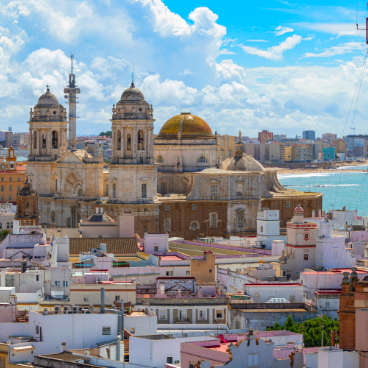
Southern Spain by train for fino & flamenco – Seville, Jerez & Cadiz

It’s standing room only at the bar, glasses of the golden, dry sherry called fino and plates of tissue-thin jamon at our elbows.

Low stools are huddled closer to the small stage for those who like to book ahead, but the rest of us stand; it’s a loud, friendly scene while the flamenco musicians warm up. Then Maria bursts through the crowd to demand our absolute attention.

And she gets it.

The cantaor (singer’s) voice cuts into my heart, even though I’ll understand his words only much, much later, his voice is wrought with melancholia.  As the late flamenco documenter Pierre Lefrance wrote, flamenco singing sees “deep grief … simultaneously expressed and controlled”.

Maria, on the other hand, is defiant and proud, a fury that lets her crash her shoes onto the timber floor, in time with the rapid hand clapping from the musicians.

I undertook a six-day tour, travelling Spain by train between Seville, Jerez and Cadiz to explore flamenco and sherry, both which claim their origins are here in southern Andalucia. A solo traveller, I found myself standing at bars to snack, to listen to flamenco, to shoot morning coffee and sip evening Oloroso, a dark, sweet sherry that is just one of the iconic sherries form this region.

Travelling with British slow travel experts Inntravel, they booked the hotels and train tickets, and issued me with a series of suggested walking tours, leaving me to guide myself through these three wonderful cities. My hotels were Las Casas de la Juderia, Seville, Casa Grande in Jerez and the 18th century Hotel Argantonio in Cadiz.

You can read my cover story about fino and flamenco in the Sydney Morning Herald and The Age newspapers.

See https://www.smh.com.au/traveller/inspiration/this-southern-spain-train-odyssey-is-ruled-by-two-f-words-20240822-p5k4cs.html

Spain by train

Tour
Inntravel’s self-guided six-night Fino & Flamenco tour travels between Seville, Jerez and Cadiz by train. Includes pre-booked train tickets, six nights’ bed and breakfast and suggested walking tours. The trip starts any day of the week from Seville. From $1300 (excludes flights). See inntravel.co.uk

Qualified sherry educator Annie B runs tapas and tabanco tours through Jerez and Cadiz (anniebspain.com)

The writer travelled as a guest of Inntravel.

The World Awaits podcast goes to Spain and Nauru

It’s been a big couple of weeks in GlobalSalsa World – Turkiye, Australia’s Northern Territory and I’ve also also refreshed my podcast, with a fresh new name and a little nipping and tucking at the format. It’s now The World Awaits podcast, and you can listen to the latest edition here .

This week, fellow travel writer Kirstie Bedford and I take you to Spain and Nauru – at opposite ends of the tourism spectrum. I interviewed one of Australia’s best known travel writers, Ben Groundwater, who is a Spain aficionado and total foodie. Ben invited me on his Flights of Fancy podcast, with Nine Media, a few times – sadly now defunct (but still live if you’d like to take a listen), so I asked him to return the favour.

After embedding himself in San Sebastian in the Basque country, for a year, Ben is a great one to chat about how overlooked Spain is outside the major hotspots such as Barcelona. You know I”m a lover of this country as well, especially after my train adventure in Andalucia last year, which started in (very touristy) Seville, but pushed on through to Jerez, Cadiz and then I ended up in Spain’s most beautiful pueblo blanco, Vejer de la Frontera. If the chat makes you hungry, you can join Ben on one of his foodie tours to San Sebastian with World Expeditions, next year.

You’ll also hear from Lisa Pagotto, founder of Crooked Compass tours. Lisa goes seriously off track in her travels – she’s talking to Kirstie about travelling in the beautiful island of Nauru, best known for its role as the host site of Australia’s detention centre for refugees (please don’t go there, a particularly ugly part of Australia’s foreign policies). I travelled with Crooked Compass on a week-long hike in Palestine a few years ago. How’s that for off-beat travel?

Anyway, tune in, I hope you enjoy the show, and let us know what you think, or where you’d like us to go next on the podcast.

Looking forward to hearing your thoughts and ideas!

You can listen on Spotify, Apple Podcasts, Amazon Music and wherever else you get good ear candy.

The dish we missed: chefs name their most delicious travel memories

After two years of lockdown here in Australia, where we couldn’t leave our country, what’s the dish you missed the most? I chatted to 10 of Sydney and Melbourne’s top chefs about those delicious travel memories they hold dear, and where they’re heading when they’re back on a plane this year.

I reckon I’m booking a ticket to Spain to take Brigitte Hafner’s recommendation for slow-cooked lamb in Rioja. Or maybe I need to go back to Turkey for Iskander kebab, which Paul Farag reminded me of. Or snapper cerviche on a beach in Lima, Peru.

If you’re not heading overseas, chefs including Shannon Martinez, Christine Manfield and Scott Pickett also shared some favourite dishes closer to home, within Australia, from dumplings at Supernormal in Melbourne to arkhe in Adelaide, for the Parfait Tartlet a la Burnt Ends.

Click here to read the story, published in the Traveller section of The Age and the Sydney Morning Herald newspapers.


Walking the Camino: a guide to finding your feet (and heart, and solutions to life’s problems)

Author John Brierley spends every spring and autumn following in the footsteps of thousands of pilgrims making their way to the medieval cathedral of Santiago de Compostela, in far western Spain. He has been walking the Camino de Santiago for 25 years.

When he is not walking, he is at home, writing and playing with his grandchildren. John has written dozens of guides for pilgrims from all walks of life, who plan to walk some of the than 80,000 kilometres of authenticated and waymarked routes that lead to , on which every nation on Earth has set foot.

But it’s not about counting your steps, monitoring your heart beat, he says.

“To experience the Camino directly, you have to listen to your heart,” says John. “Listen well; it might only come as a whisper. But beware! If you have truly heard the call, you have become infected by a disease which will become fatal to your limited ego identity.”

I interviewed John for my The Knowledge column in the Traveller section of the Sydney Morning and The Age newspapers, and his passion is infectious. I do believe that was his aim: to get me on the route.

“Our troubled world is crying out for solutions to the war and injustices that are raging everywhere we look,” he told me in our interview while he was in Australia recently. “But we have been looking for answers in the wrong direction. We have been looking out, not in.”

“The Camino asks us to step out of our comfort zone and to take some risks.The solutions we seek can only be found in the stillness of our own hearts and minds. ”

“That is the incredible gift of the Camino – it provides time in the silence of nature to empty out our outworn belief systems and allows time new insights to arise in the spaciousness of higher Mind.”

See caminoguides.com

To read the column in the Traveller section of the Sydney Morning Herald and The Age newspapers, click here.

Healthy hiking holidays: from Patagonia to Tasmania and Spain’s classic Camino

Last month, I found myself hiking along a section of Chilean Patagonia’s most famous walking route, the W.

The route curls around the Paine Massif, a majestic family of jagged peaks, whose tops were shrouded in cloud and cloaked in snow. Condors hunted between their teeth, and the air jolted to the sound of avalanches, hundreds of meters above me.

It all taps into the recent story I wrote for Prevention magazine, a women’s health publication, about five great hiking holidays. In it, I included the W, but also Tasmania’s new Three Capes Walk and the Larapinta Trail in Australia’s Northern Territory, as well as the Kumano Kodo in Japan and the Spanish classic ultra-long walk, the Camino de Santiago.

Why do we walk? To get fit? To slow down? To go on pilgrimage?

The benefits include better health and spending time in nature, while some walks, like the Kumano Kodo and the Camino, were very deliberately designed to create time to clear your head and sift and sort through the bigger problems in life,  says Di Westaway, founder of Wild Women On Top.

“Finishing a trek that takes you outside your comfort zone is a confidence-building exercise. It might be really arduous at high altitude, with plenty of “OMG, what was I thinking?” moments, but that exhilaration and achievement afterwards is a huge personal lift,” Diane adds.

You can read the story online, or you can just pull your hiking boots on now…

Egyptian style makes a comeback in ‘balady chic’ movement

lanternsLast year, I was building a kitchen in my apartment in Cairo. I knew the tiles I wanted – classic arabesque style. You know, I wanted something out of an Andalusian palace or a Turkish mosque in my kitchen, please. I showed a photo to the tile salesman, who smarmily told me that they don’t have those tiles in Egypt.

“You don’t have those tiles? They’re along the walls of the ahwa (traditional café) downstairs!” I fumed.

The roll of his eyes said what his mouth wasn’t saying: “So old-fashioned, crazy foreigner.”

Happily, I found the traditional tiles, now made by a savvy Spanish company (and paid a bomb for them). Since then, I’ve spotted these (new) tiles everywhere, as part of a resurgence in what’s been dubbed ‘balady chic’. The word balady translates as ‘my country’ or ‘local’. So balady chic celebrates traditional Egyptian design, and it’s coming from the cool kids of Cairo.

This trip, I found an awesome tray featuring a reworking of the Hamza, or hand of Fatima, a powerful symbol that wards off evil, from local manufacturer Joud (it’s website is joudness.com – but Egyptians pronounce the ‘j’ as a ‘g’ – cute). I also raided the fabulously haphazard, historical market Khan al-Khalili yet again for yet more beautiful metal light shades (nagafa), belted into elaborate forms in the noisy, dark metal workshops spotted throughout Islamic Cairo. And they’re not a new story, but the handmade soaps (think: milk & honey, and olive oil – how much more Arabian can you get?) and organic cotton towels from Nefertari found their way into my bag for Christmas presents (see nefertaribodycare.com).

Easy on the eye, and better in the stomach, the hottest place in the upmarket, Nile-side part of Maadi is Baladina, for classic Egyptian food such as fatta and shawarma, beautifully done and served, rather ironically, by slim-hipped waiters in gellibayas and little white cotton caps. In fact, there are a few cool, new Egyptian food chains in town: try the ‘healthy’ koshary, made with green wheat and brown rice, at Zooba, Cairo Kitchen published its fantastic cookbook last year and I love El Dokan’s balady décor.

So great to see Egyptians taking pride in their own design history. Long may it last (before it gets copied by knock-off foreign companies).

Beautiful game, beautiful life: Camp Nou, Barcelona

Big thanks to the man about the house for dragging me to Camp Nou, headquarters of Barcelona Football Club, to see his club in action. My story on the passion and the fashion of the beautiful game was published in the Sydney Morning Herald this weekend. (For the record, I did get him to visit Sagrada Familia.)

campnou

Action at Barcelona’s Camp Nou. Photo: Belinda Jackson

Forget Michelin stars, and Gaudi who? There’s only one reason to visit Barcelona.

The message is clear. “I only want to go to Barcelona to see Barcelona Football Club play,” says the husband, shelving any ideals of visiting Sagrada Familia or eating at world-famous restaurants.

We’re staying at one of the best addresses in town – the new suites in the Mandarin Oriental Barcelona – and the entrance is a dramatic catwalk up from street level. The lobby is sleek and hushed, the staff as polished as only five-star staff can be. Yet in Barcelona, football transcends gender and poshness.

In Barcelona, football certainly appeals to shoppers: the city’s new-town grids and old-city lanes conspire to walk me into one of dozens of official FC Barcelona boutiques selling balls and caps, water bottles and pencil cases. A genuine FC Barcelona shirt will set you back €80 ($124), even though it’s a sweaty 100 per cent nylon and manufactured in Vietnam or Bangladesh.


To read more about kicking off in Barcelona, click here.

This story was published in the Sydney Morning Herald newspaper’s Traveller section.

Save

Save

Beautiful game, beautiful life: Camp Nou, Barcelona

Action at Barcelona’s Camp Nou.
Photo: Belinda Jackson

Big thanks to the man about the house for dragging me to Camp Nou, headquarters of Barcelona Football Club, to see his club in action. My story on the passion and the fashion of the beautiful game was published in the Sydney Morning Herald this weekend. (For the record, I did get him to visit Sagrada Familia.)

Forget Michelin stars, and Gaudi who? There’s only one reason to visit Barcelona.

The message is clear. “I only want to go to Barcelona to see
Barcelona Football Club play,” says the husband, shelving any ideals of
visiting Sagrada Familia or eating at world-famous restaurants.

We’re
staying at one of the best addresses in town – the new suites in the
Mandarin Oriental Barcelona – and the entrance is a dramatic catwalk up
from street level. The lobby is sleek and hushed, the staff as polished
as only five-star staff can be. Yet in Barcelona, football transcends
gender and poshness.

In Barcelona, football certainly appeals to shoppers: the city’s
new-town grids and old-city lanes conspire to walk me into one of dozens
of official FC Barcelona boutiques selling balls and caps, water
bottles and pencil cases. A genuine FC Barcelona shirt will set you back
€80 ($124), even though it’s a sweaty 100 per cent nylon and
manufactured in Vietnam or Bangladesh. 

Freedom of expression! Catelan activists at Camp Nou.
Photo: Belinda Jackson

To read more about kicking off in Barcelona, click here.

This story was published in the Sydney Morning Herald newspaper’s Traveller section.

Global Salsa

Well, you’ve scrolled this far. What do you think? Drop me a line, I’d love to hear from you.

Privacy Settings
We use cookies to enhance your experience while using our website. If you are using our Services via a browser you can restrict, block or remove cookies through your web browser settings. We also use content and scripts from third parties that may use tracking technologies. You can selectively provide your consent below to allow such third party embeds. For complete information about the cookies we use, data we collect and how we process them, please check our Privacy Policy
Youtube
Consent to display content from - Youtube
Vimeo
Consent to display content from - Vimeo
Google Maps
Consent to display content from - Google